
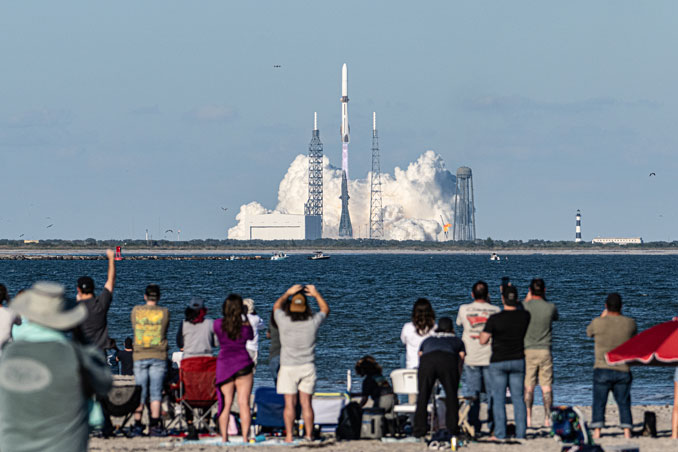
Blue Origin launched its second heavy-lift New Glenn rocket on Thursday, carrying two small NASA satellites on a long, looping course at Mars to observe how the sun has gradually eroded away the Red Planet’s once dense atmosphere.
The centerpiece of Amazon- and Blue Origin founder Jeff Bezos’ space ambitions, the seven methane-burning main engines of the massive 321-foot-tall New Glenn rocket ignited at 3:55 a.m. EST, propelling the booster skyward with 3.8 million pounds of thrust.
The launch was delayed four days due to stormy weather on Earth and in space, where a powerful solar storm hit the upper atmosphere with a torrent of high-energy radiation that could have caused electrical problems with the rocket or its payload.
The storm had subsided by Thursday’s launch, and Blue Origin crews, watching from sites several miles away from the launch pad at Cape Canaveral Space Force Station, were cheering and clapping as the booster climbed skyward, moments later as the loud roar of its engines spread across the Space Coast.
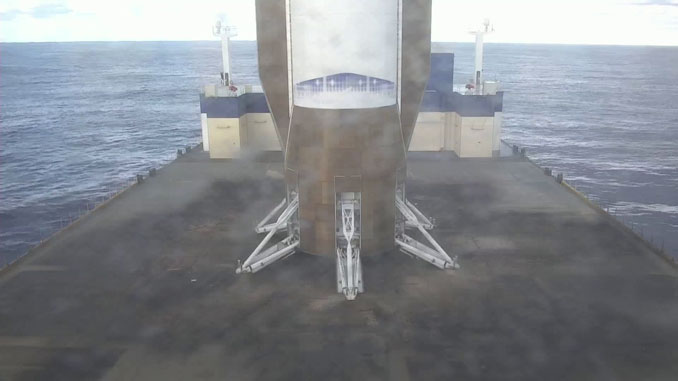
New Glenn’s maiden flight last January successfully delivered a Blue Origin payload to orbit, but the reusable first stage failed in an attempt to reach the off-shore landing ship, named after Bezos’ mother Jacqueline.
The 188-foot-tall first stage, nicknamed “Never Tell Me the Odds,” launched Thursday and features a number of upgrades to improve performance.
Like the SpaceX booster landing, the New Glenn stage fired three engines to slow for re-entry, then restarted the engines just before touchdown, followed by landing on single engine power.
This time, the booster made an on-target, picture-perfect landing, prompting another round of loud cheers and applause from Blue Origin workers.
Like the returning SpaceX Falcon 9 rocket, the larger New Glenn booster will be taken back to Port Canaveral and, depending on its condition, refurbished and prepared for use in an upcoming New Glenn flight.
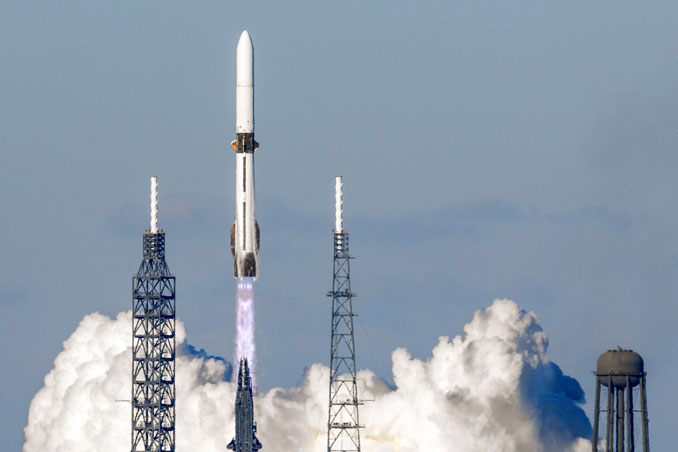
Meanwhile, the second stage proceeded, firing two of its twin engines to reach the planned Earth-escape trajectory. Thirty-three minutes after liftoff, the ESCAPADE satellites were released to fly on their own.
The NASA-sponsored payload, which is managed by the UC-Berkeley Space Science Laboratory, is composed of two small, low-budget satellites known as Blue and Gold that are central to the ESCAPADE mission. The acronym stands for ESCAPE, Plasma Acceleration and Dynamics Explorers.
The probe was built by RocketLab for UC-Berkeley under a NASA program aimed at developing low-cost, fast-track planetary missions.
ESCAPADE cost $107.4 million, a bargain compared to the cost of more conventional, more sophisticated planetary spacecraft, which can cost hundreds of millions to well over a billion dollars.
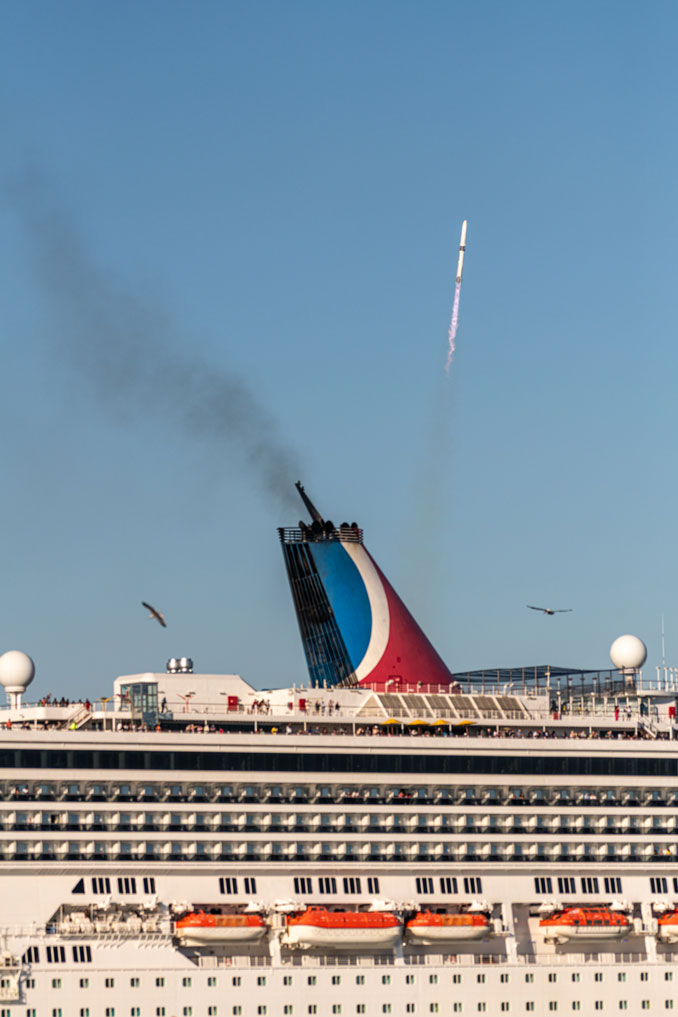
The ESCAPADE probe was originally expected to partner NASA’s Psyche asteroid probe to Mars a few years earlier. But for a variety of reasons, the Mars satellite mission ultimately ended on New Glenn’s second flight.
Mars launch windows typically open every two years when Earth and the Red Planet reach favorable positions in their orbits to allow direct flights using current rockets. The next such window will open in 2026.
To execute Wednesday’s New Glenn launch in 2025, mission planners at Advanced Space LLC created an innovative flight plan that will take Blue and Gold longer to reach Mars but enable a more flexible trajectory for future missions.
The probes were deployed on a trajectory that would take them a million miles, well beyond the orbit of the Moon, where they would linger for the next 11 months before heading back toward Earth.
Passing within 600 miles of Earth in November 2027, the ESCAPADE probe will perform a velocity-boosting gravity-assisted flyby, augmented by on-board propulsion, ultimately headed to Mars.
In total, the twin spacecraft will spend a full year in the initial kidney bean-shaped orbit out and back from the Moon and another 10 months in transit to Mars. The probe will not reach the red planet until September 2027.
“We’re using a very flexible approach where we go into a slow orbit around Earth then wait until Earth and Mars are lined up correctly to go to Mars in November next year,” said principal investigator Robert Lillis.
“This is an exciting, flexible way to get to Mars because in the future… we can potentially queue up spacecraft using the approach that ESCAPADE is pioneering” without waiting for a planetary launch window to open.
While the ESCAPADE mission is modest compared to Mars rovers and more sophisticated orbiters, the probe is designed to answer important questions about the evolution of the Martian atmosphere.
Mars once had a global magnetic field like Earth’s, but its molten core, which powered that field, had mostly frozen in place long ago and magnetic deposits left only scattered, isolated remnants of that once protective field.
Without an Earth-like protective global sphere, the Martian atmosphere constantly faces dense clouds of high-speed electrons and protons blasted from the Sun and charged particles by powerful solar storms.
Working in tandem, first at different distances from each other in the same orbit and then from different altitudes, Blue and Gold will measure how energetic electrons and protons from the solar wind and solar storms interact with the Martian atmosphere.
Data from earlier Mars satellites has shown that the planet’s atmosphere is constantly being stripped away by those interactions, but how this happens over time is not fully understood.
“We really want to understand the interaction of the solar wind with Mars better than we do now,” Lillis said. “We know that atmospheric escape from Mars is a major driver of the evolution of Mars’ climate.
“We know that Mars was occasionally warm and wet for at least a few billion years, but not for about two billion years. And we think atmospheric escape is a major cause of that.”
The blue and gold will provide a stereo view of those processes.
“If you only have one spacecraft, you can either measure what the Sun is throwing at Mars, the so-called space weather environment overhead of Mars, or you can measure the conditions closer to Mars in its upper atmosphere, where the atmosphere is escaping,” Lillis said.
“You can’t be in two places at once. But we can, because we have two spacecraft to do it. So we can actually get that cause and effect at the same time. We’ve never done that before, and it’s really exciting.”


