
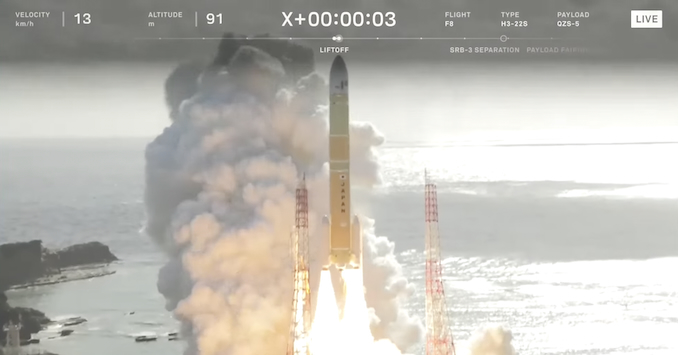
A flight of Japan’s H3 rocket ended in failure on December 22 after the upper stage experienced an anomaly.
In a statement after the launch, the Japan Aerospace Exploration Agency (JAXA) pointed to a problem with the LE-5B-3 engine, which is powered by a combination of liquid hydrogen and liquid oxygen.
“The second ignition of the second stage engine failed to start normally and shut down prematurely,” JAXA said. “As a result, QZS-5 could not be placed in the planned orbit, and the launch failed.”
The rocket lifted off at 10:51 a.m. JST (0151 UTC) from Tanegashima Space Center on December 22, and the rocket’s first stage performed nominally. According to the planned mission timeline, there were two planned burns of the upper stage.
The second burn was scheduled to last more than four minutes, but it ended suddenly.
“It will be impossible to conduct the next liftoff without determining the cause (of the failure) and implementing preventive measures,” JAXA project manager Makoto Arita said at a press conference, according to Japan Wire by Kyodo News. The news conference following the anomaly was entirely in Japanese.
Its payload, QZS-5 (Quasi-Zenith Satellite System) was the sixth satellite launched to provide local navigation services to Japan to augment the Global Positioning System (GPS) satellites managed by the United States.
This is the second time that the H3 rocket has suffered a second stage anomaly since its launch in March 2023. That was the first failure for the inaugural flight program.
Since then, the rocket’s manufacturers Mitsubishi Heavy Industries (MHI) and JAXA have flown five successful missions with the 63-metre-long (207 ft) rocket. The most recent of those was the October 26 launch of the HTV-X cargo spacecraft, which flew to the International Space Station.


