
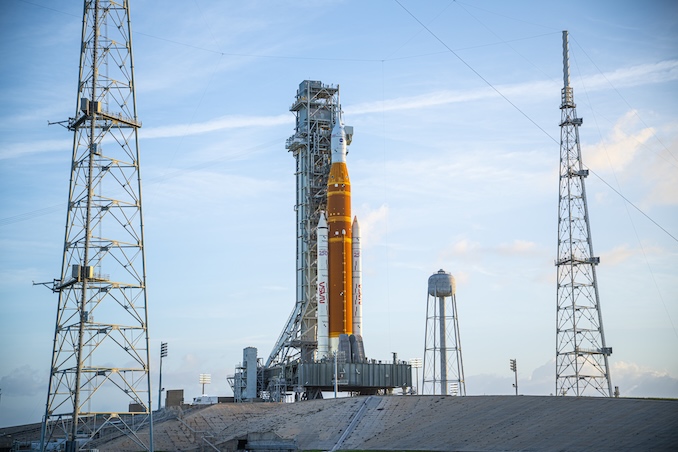
For the first time in more than 53 years, NASA is preparing to send humans beyond low Earth orbit. As soon as Wednesday evening, four astronauts will depart on a more than nine-day mission with the goal of flying around the moon and back.
The flight is called Artemis 2 and is the first crewed flight of the Orion spacecraft, a key step in grand plans for a moon base and eventually human exploration of Mars. NASA astronaut and mission commander Reed Wiseman leads the quartet, which also includes fellow NASA astronauts Victor Glover and Christina Koch, as well as Canadian Space Agency astronaut Jeremy Hansen.
“The vehicle is ready. The systems are ready. The crew is ready. And there is a mission behind this flight: a landing, a lunar base, a nuclear propulsion in deep space. It starts, not ends, with what happens on Wednesday,” NASA Associate Administrator Amit Kshatriya said Monday.
“I have full confidence in this team and the NASA workforce.”
The more than 49-hour-long countdown officially began at 4:44 p.m. EDT (2044 UTC) monday. Artemis launch director Charlie Blackwell-Thompson will give his approval Wednesday at 7:34 a.m. EDT (1134 UTC) to proceed with refueling the 322-foot-tall Space Launch System rocket.
Spaceflight Now will have live coverage of the Artemis 2 mission beginning approximately 10 minutes before the vote to refuel. Liftoff is scheduled for 6:24 p.m. EDT (2224 UTC), the opening of a two-hour window.
The 45th Weather Squadron estimates a 20 percent chance of a weather violation during Wednesday’s launch window. During a news briefing Tuesday, Launch Weather Officer Mark Berger said the risk of lightning was low, but added that they were keeping an eye on the possibility of interference from cumulus clouds and strong ground winds.
“The optimistic side of me says there’s an 80 percent chance of a ‘go’ here. Again, there are isolated showers moving around, but again, there’s a lot of real estate between those showers, in all likelihood,” Berger said. “We should be able to find some clean air to launch Artemis 2.”
Regarding weather in the rocket’s ascent corridor, he said conditions heading into the planned launch window were “very ‘going’,” adding that the risk probability was a total of 9 percent, which he said was “pretty good.”
If everything goes smoothly with the multi-hour refueling process, the four crew members will begin donning their flight suits – formally called Orion Crew Survival System (OCSS) suits – about 5.5 hours before liftoff. After emerging from the suit-up room, they will spend a few final minutes face-to-face with their families, before taking a 30-minute car ride to the launch pad.
Once they arrive at Launch Complex 39B, a small team called the Closeout Crew will help them into their Orion spacecraft, which the astronauts have named ‘Integrity’. That’s all they need aboard the ship and more to survive and function aboard the spacecraft, which they will call home for more than a week.
Orion has a habitable volume of 330 ft³ (9.34 m³), which NASA said is equivalent to combining two small minivans.
After the crew is safely aboard, the side hatches of the crew module and launch abort system will be sequentially closed and sealed. The closeout crew, which includes one of the backup astronauts for this mission, will finish storing their equipment and clearing the pad less than an hour before flight.
After liftoff is achieved, the twin five-segment solid rocket boosters will separate from the rocket’s core stage a little more than two minutes into flight. The SLS rocket’s upper stage – called the interim cryogenic propulsion stage – will separate from the main stage in the eighth minute of the mission.
20 minutes after liftoff, four, 23-foot-long (7 m) solar arrays on the European Service Module (located below the crew module) will deploy and begin providing power to Orion’s four main batteries.
The ICPS will perform its first major burn, called a perigee maneuver, 49 minutes after liftoff, placing Orion into an elliptical orbit at 1,381 x 115 statute miles. This will be followed about an hour later by the apogee maneuver, which will place Orion into high Earth orbit at 43,730 x 0 statute miles.
About two hours after that, Orion will separate from ICPS and begin a one-hour manual piloting demonstration. Wiseman and Glover will take the stick and bring the spacecraft about 10 meters away from the upper stage to demonstrate the vehicle’s maneuverability, which will be needed for future docking operations with Blue Origin and SpaceX landers.
The crew will then be able to sleep for approximately four hours before they are woken up by another perigee burning to close out Flight Day 1 and return to sleep again. At that time, they will be in an orbit of 44,555 x 115 statute miles.
The big decision point will come Thursday when NASA will ask whether the spacecraft and crew are ready for their journey to the Moon. If so, the main engine on Orion’s service module will fire up for trans-lunar injection (TLI) in less than two hours on Flight Day 2.
There are some abort options that would prevent the crew from going to the Moon if necessary, but making a U-turn would become less favorable the further the crew advanced.
Depending on the time and day of their launch, they are set to see parts of the moon’s far side that humans have never seen directly with their eyes. Those unique observations will help researchers understand more about the moon’s composition, and the journey will help NASA and its partners learn more about Earth’s atmosphere and the safety of living in a radiation environment beyond that.
meet the crew
Learn more about the four people who will be the first people to live and work aboard the Orion spacecraft.

