
Update June 17, 11:20 a.m. EDT (1520 UTC): Arianespace confirms deployment of all Amazon LEO satellites.
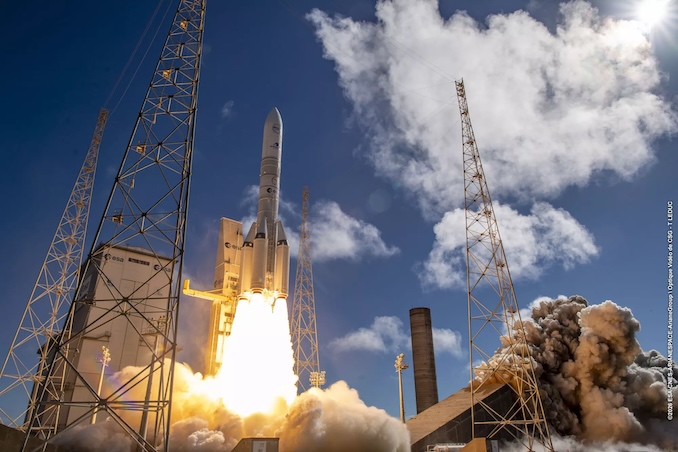
Arianespace launched its largest and heaviest payload ever on a version of its Ariane 6 rocket featuring new solid rocket boosters on Wednesday morning.
The mission was designated VA269 by Arianespace and LEO Europe 03 (LE-03) by Amazon. It sent 36 Amazon LEO broadband internet satellites into low Earth orbit.
It was the third of 18 Ariane 6 flights booked by Amazon LEO to deploy its constellation and follows successful flights in February and April.
“We have both institutional and commercial customers and our main and biggest customer today is Amazon. And I must say we are very proud to work together,” said David Cavalloes, CEO of Arianespace, during a pre-launch press briefing. “To me, it’s more than a contract. It’s really a partnership.”
The liftoff from Europe’s spaceport in French Guiana occurred at 9:21 a.m. Kourou time (8:21 a.m. EDT/1221 UTC).
While all three Amazon LEO missions for Arianespace have used the Ariane 64 configuration of rockets with four solid rocket boosters, the LE-03 mission will debut an upgraded version, called the P160C.
Compared to the preceding P120C design, the P160C is one meter longer and holds approximately 156 tonnes of solid propellant. This is approximately 14 tons more than the P120C booster, which can increase the launcher’s performance by 10-15 percent.
The P160C boosters can generate 3,800 kN of thrust each at liftoff, while the P120C boosters generate 3,700 kN of thrust. This iteration of Ariane 64 can deliver 36 Amazon LEO satellites into orbit, four more than before.
Cavaloles said this upcoming launch is a major milestone for the company.
“It is important and we want to secure this milestone. This has been our focus to date, but of course, the story does not stop here,” Cavaloles said. “The more launches we do, the better we know the launcher. We are already considering further improvements. So we will try our best to increase the performance of the launcher and thus we can increase the number of satellites for each launch.”
For the first time, Ariane 64 will fly with four P160C boosters.
📏 P120C to +1 meter longer
🔥 156 tons of propellant pic.twitter.com/q5gdSWT274— Arianespace (@Arianespace) June 4, 2026
Less than 2.5 minutes after liftoff, the four P160C boosters separated from the Ariane 6 main stage, with fairing jettisoning occurring less than a minute later. About eight minutes into flight the first and second stages separated and the Vinci engine began the first of two burns before deployment.
The deployment sequence for the Amazon LEO satellites began about an hour and a half after liftoff and ended about an hour and 51 minutes after liftoff. The Vinci engine performed a de-orbit burn approximately two hours and 40 minutes after liftoff.
“When this mission is completed, Arianespace will have launched 100 of our satellites to date. That’s three missions in less than five months, which is tremendous,” said Steven Metayer, vice president of production operations at Amazon.
“This is something we really count on to drive up rates across all providers.”
formation of a constellation
Ahead of Wednesday’s launch, Amazon has deployed 331 satellites on 12 missions by three different launch providers: Arianespace, SpaceX and United Launch Alliance.
Metayer said production of satellites is increasing rapidly and is exceeding the rate at which they are currently able to put them into orbit. He said Amazon is currently building “several satellites per day” at its facilities in Washington state.
In Florida, he said they were able to get the satellites to their payload processing facility at NASA’s Kennedy Space Center and integrate them into a dispenser in about a week.
“We’re comfortable right now ahead of launch. We know when these heavy lift vehicles, such as the Ariane 64, and then you add Vulcan and New Glenn to that, we know we’ll have a lot of consumption rate demand from launch,” Metayer said. “So we are comfortable building ahead of what we need at this time and making sure our satellites never run out.”
Those two launchers, New Glenn and Vulcan, are both down indefinitely.
For ULA, its Vulcan rocket has been grounded due to a problem with one of its solid rocket boosters during the USSF-87 mission in February. The timeline for the conclusion of its anomaly probe is not publicly known, but Metayer said Amazon is hoping to be able to launch its first LEO Vulcan mission “in the third quarter, late third quarter.”
ULA has placed its first Vulcan rocket that will carry Amazon LEO satellites inside the newly built Vertical Integration Facility – Amazon (VIF-A) at Cape Canaveral Space Force Station’s Space Launch Complex 41. The rocket will head to the pad this summer for a wet dress rehearsal to validate ULA’s new Centaur upper stage, which the company has optimized for low Earth orbit missions.
Preparations continue for LEO Vulcan 1 (LV-01), the first of 38 Vulcan missions on contract with @ULAlaunch.
The teams have completed the integration of the first LEO-optimized Centaur upper stage with Vulkan inside Amazon’s dedicated Vertical Integration Facility (VIF-A),… pic.twitter.com/2BZgecrbbl
— Amazon Leo (@Amazonleo) June 2, 2026
On the Blue Origin side of the equation, a month after recovering from an upper stage flight anomaly on its NG-3 mission, the company lost its only launch pad in the explosion of its New Glenn rocket during a static fire test on May 28.
During an appearance at the annual VivaTech conference in Paris on Wednesday, Blue Origin CEO Dave Limp confirmed the company’s goal of resuming launches from the Cape Canaveral Space Force Station by the end of the year.
Limp told panel moderator and former NASA astronaut Mike Massimino, “We brought in 400 pieces of heavy equipment, brought in construction workers who were working 24/7. And so now all the debris has been removed from the pad. It’s amazing how quickly that happened.” “Just yesterday, we started rebuilding. We’re going to take off this year.”
Metayer said the 24 launches purchased using New Glenn rockets represent “less than 25 percent of our total.”
“We certainly want to see New Glenn come into service and we’re certainly looking forward to flying on them, but they’re not the only provider,” Metayer said. “We have a diverse launch portfolio to intentionally do that and we have quite a few launches coming up on others.”
Metayer said Amazon plans to launch multiple launch vehicles this year, about six times. The next mission after the Ariane 64 mission on Wednesday is expected to be the LEO Atlas 08 mission on July 3, which will be the last non-governmental launch of the Atlas 5 rocket.
He said they also have another Ariane 64 launch scheduled this year, but did not say when. Here is the current lineup of launchers purchased by Amazon:
- ULA’s Vulcan – 0/38
- ULA’s Atlas V – 7/9 (the one used for the protoflight mission)
- Blue Origin’s New Glen – 0/24
- Arianespace’s Ariane 6 – 2/18
- SpaceX’s Falcon 9 – 3/13
Metayer said the reliability of Arianespace has been important to the company since its inception as it grows its group.
“They’ve definitely stepped up, you know. I will say, they’ve been very reliable on their reveal dates, they’ve been very reliable and safe on their insertion into orbit,” he said. “So we will certainly continue to look forward to the next 16 launches with him on his current contract and we see him as a long-term player beyond that.”
Amazon faced a challenging deadline with the Federal Communications Commission because it originally needed to deploy and operate half of its 3,232 satellite constellation by July 30, 2026.
However, earlier this month, the FCC granted the exemption requested by the tech giant, but without certain conditions.
“Specifically, we impose meaningful conditions on Amazon LEO that incentivize the company to continue deploying faster satellites by temporarily reducing the spectral priority of satellites launched after the relevant July 2026 milestone deadline, until Amazon LEO builds those satellites at a faster rate,” wrote Jay Schwarz, head of the FCC’s Space Bureau. “We take into account the specific record developed today on Amazon LEO and will thus encourage a faster build and launch.”
They further stated that “Any authorized satellite in the Gen1 authorization that is not deployed and operational will temporarily lose the corresponding priority status granted in both the 2020 Ka/Ku-band processing round and the 2021 V-band processing round and will subsequently be reassigned to priority status. This loss of status will last for twenty (20) months – until March 30, 2028 – or until 50% of the constellation is launched and operational. It doesn’t happen, whatever happens first.”


