
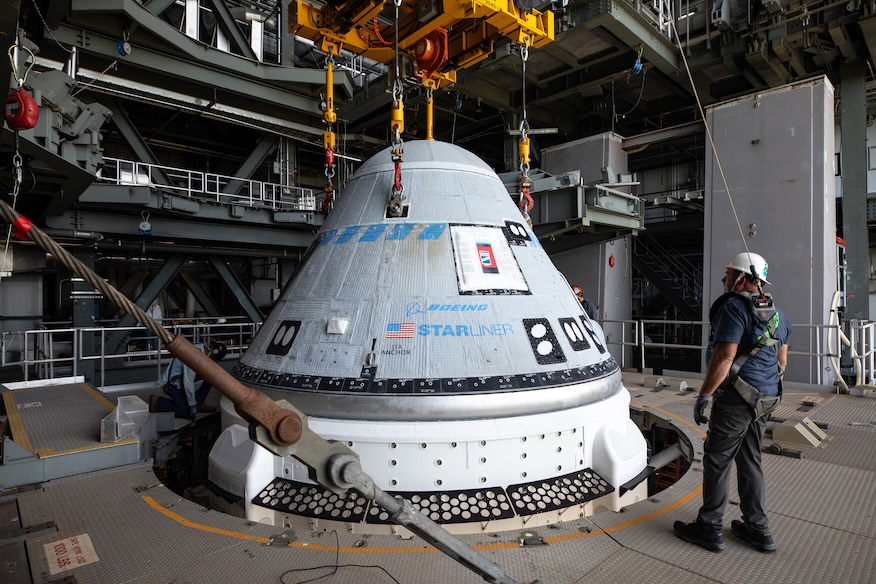
In its latest change to the Commercial Crew Program, NASA announced Monday that it has reduced the number of missions required by Boeing to fly to the International Space Station and changed the next flight from a crew mission to a cargo mission.
The original contract awarded by NASA to Boeing and SpaceX called for each to conduct an uncrewed demonstration flight to the ISS, followed by a crewed demo mission, and then six regular crew rotation missions.
Both companies launched their uncrewed demo flights in 2019, but their trajectories have since diverged dramatically. SpaceX was able to proceed with its crewed demo mission with its Dragon spacecraft, named Demo-2, in May 2020 and has flown 12 NASA crewed missions to the orbiting outpost to date.
Boeing, meanwhile, had to repeat its unmanned flight in 2022, called Orbital Flight Test 2 (OFT-2), after the 2019 Orbital Flight Test encountered problems that prevented the spacecraft from reaching the space station. The 2024 Crew Flight Test (CFT) also encountered a number of issues, primarily involving Starliner’s thrusters, which ultimately resulted in NASA ordering the capsule to return without a crew in September and the CFT astronauts coming home in a SpaceX Dragon capsule.

Since the conclusion of the Starliner CFT mission, NASA and Boeing have debated whether or not the next flight of Starliner will carry astronauts, with each public statement from NASA casting doubt on crewed flight.
Monday’s announcement made it official that the mission, called Starliner-1, will be a cargo-only flight to the ISS, launching no earlier than April 2026.
“NASA and Boeing are rigorously testing the Starliner propulsion system in preparation for two potential flights next year,” Steve Stich, manager of NASA’s Commercial Crew Program, said in a statement. “This modification allows NASA and Boeing to focus on safely certifying the system in 2026, executing Starliner’s first crew rotation when ready, and aligning our ongoing flight planning for future Starliner missions based on the station’s operational requirements through 2030.”
NASA and Boeing also agreed to reduce the number of NASA flights to purchase from Boeing from six to four, “with the remaining two available as options.” And with the decision for Starliner-1 to be cargo-only, that means NASA can only have three flights with Starliner that will carry its astronauts to the ISS.
If Starliner-1 is a nominal flight, it opens the door for Starliner-2 to become Boeing’s first operational mission to the space station with a crew.
A NASA spokesperson said, “The next commercial flight to the International Space Station without a specific provider is scheduled for no later than October 2026. This flight will be assigned with NASA’s SpaceX Crew-12 mission, which is targeted for launch in early 2026.”
What about astronauts?
The next crew of the Boeing CST-100 Starliner spacecraft is now somewhat of a mystery, at least from the public perspective. NASA astronaut Scott Tingle, who was named Starliner-1 commander in September 2022, was named this month as the newest head of NASA’s Astronaut Office.
When Tingle was announced, the agency also said that astronaut Mike Fincke would be the Starliner-1 pilot. However, she and Japan Aerospace Exploration Agency (JAXA) astronaut Kimiya Yui, another astronaut assigned to Starliner-1, were both assigned to fly as members of the SpaceX Crew-11 mission, which is currently in progress.

Spaceflight Now reached out to the Canadian Space Agency to learn more about the fate of its astronaut, Joshua Kutryk, who was assigned to fly the Starliner-1 mission as a mission specialist. We are waiting to hear the reply.
Ars Technica senior space reporter Eric Berger reported last week that NASA astronaut Luke Delaney was also at one point in line to train for the Starliner-1 mission, but he has been reassigned to the SpaceX Crew-13 mission.
There are some astronauts who have trained to fly on Starliner and have been reassigned to fly on SpaceX’s Dragon spacecraft who could potentially be assigned to the Starliner-2 flight, assuming everything goes well with this next cargo mission.
Nicole Mann was one of the original members of the Starliner Crew Flight Test Mission before being assigned to SpaceX Crew-5. He was selected along with NASA astronaut Eric Boe, who withdrew his name after some time due to medical reasons.

The only other active astronaut who has been publicly confirmed to have trained on the Starliner system is CFT pilot Sunita ‘Sunny’ Williams. However, given that Starliner-2 will be his fourth mission after spending more than 600 days in space, he may go up against radiation limits for NASA astronauts.
Below is a list of astronauts who have retired from active service and who trained to fly on Starliner (for either the CFT or Starliner-1):
- josh casada
- Janet Epps
- Chris Ferguson
- Koichi Wakata (JAXA)
- Barry ‘Butch’ Wilmore


