
Researchers using two of humanity’s most powerful observatories – NASA’s James Webb and Hubble Space Telescopes – have definitively shown that Terzan 5 is not a globular star cluster as it was once classified, providing new insight into how galaxies like our own form and evolve over time. A globular star cluster usually contains only one ancient star population. The new data not only confirms the existence of two distinct populations of stars in Terzon 5, but also provides evidence of two more recent rounds of star formation. Although located within the crowded bulge of our galaxy, the central, globular region of old stars in our galaxy, Terzon 5 was massive enough to retain its own identity while lighter-weight systems spread out and mixed to form the bulge billions of years ago. It’s like a lump in an otherwise well-mixed cake batter.
“Webb’s new near-infrared observations, cross-referenced with Hubble’s archival observations, have given us a very clear picture of the history of Terzon 5,” said Giorgia Zullo, who led the research and is a PhD student at the University of Bologna in Italy.
The results were presented at a press conference Tuesday at the 248th meeting of the American Astronomical Society in Pasadena, and published in Astronomy & Astrophysics.
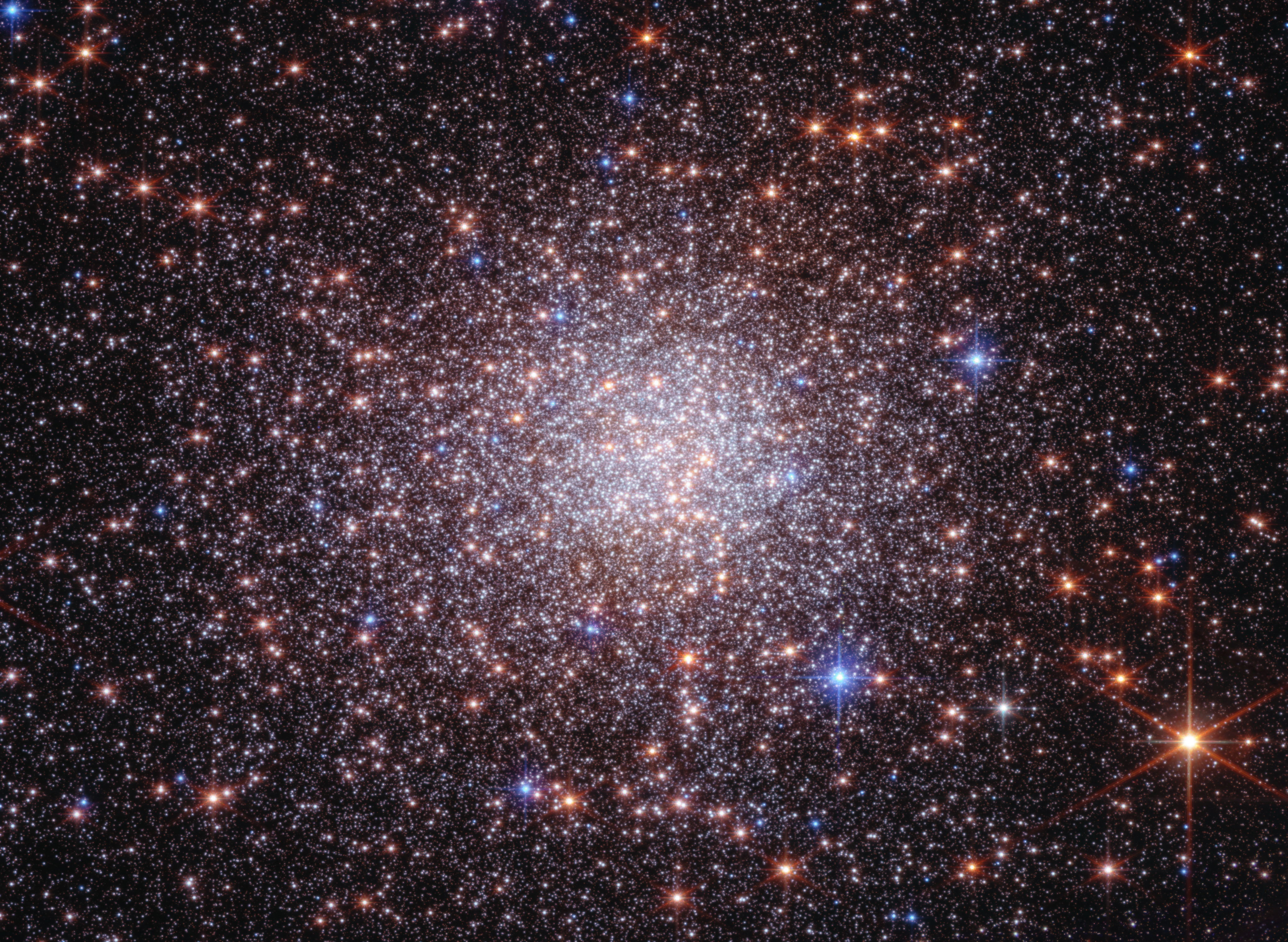
Webb’s new observations, along with many of Hubble’s observations, prove that Terzan 5 is a self-contained, self-enriched stellar system consisting of four distinct star populations. It orbits within the central bulge of our galaxy.
Image: NASA, ESA, CSA, STScI, Giorgia Zullo (University of Bologna), Francesco Ferraro (University of Bologna); Image Processing: Alyssa Pagan (STScI)
Discovered by astronomer Aesop Terzan in 1968, Terzan 5 resembles a globular cluster in many ways. However, in 2009 the system was discovered to harbor two distinct populations of stars. In 2016 Hubble provided the first estimate of their ages, showing that one formed about 12 billion years ago – when the galaxy itself was coalescing – and the other about 5 billion years ago, just before the Earth formed. This pointed to a more complex history than that of a typical globular cluster.
The study of Terzon 5 is complicated by its location in a region of our galaxy filled with stars and heavily obscured by dust. This is where the web stepped in. Its infrared view allowed the research team to see through the dust and catalog many more stars, and fainter stars, than previous work. By measuring the color and brightness of stars, astronomers can classify them into populations of different ages and chemistries.
Webb was able to measure these key properties for every star within the field of view in the sky – both the stars within Terzon 5 and the unrelated foreground stars. To isolate Terzon 5’s stars, the team relied on Hubble’s power and longevity. The 12-year separation allowed the team to measure very small movements of individual stars, known as proper motions, to determine which stars belong to Terzon 5 and which are part of the galaxy bulge.
Combining data from both Webb and Hubble, the researchers found strong evidence for two more stellar populations, one that formed 3.8 billion years ago and the other only 2.5 billion years ago. They were also able to determine the ages of previously known stellar populations with unprecedented accuracy, revealing that they formed between 12.5 billion and 4.7 billion years ago.
With two generations of stars already known, astronomers could not rule out the possibility that Terzan 5 interacted with another object, such as a globular cluster or giant molecular cloud, which became enriched with new gas and dust, triggering a second round of star formation. With four stellar generations, those explanations have been rejected.
Measurements of the stellar composition of the Terzan 5 population made at the WM Keck Observatory and the European Southern Observatory’s Very Large Telescope also point to very different populations. “Along with the age of these populations, the clusters preserve a fossil record of progressive enrichment of heavy elements by supernovae,” said co-author R. Michael Rich, a research astronomer at the University of California, Los Angeles.
Terzan 5 produced several generations of stars because it was able to retain the necessary raw materials. Terzon 5 contains evidence of powerful supernova explosions that created heavy elements that were blown away by later generations of stars. In lighter-weight systems, the force of the explosions themselves could expel the resulting elements as well as any remaining gas and dust. The progenitor of Terzon 5 had enough mass to sustain the emissions of those stars, leading to the formation of new generations of stars over billions of years.
The results suggest that Terzan 5 is likely a remnant of a much more massive stellar system that initially formed 12.5 billion years ago. Terzan 5 is extraordinary because it survived—and never merged or completely “mixed” with the galaxy’s bulge. Francesco R., a professor at the University of Bologna and principal investigator of Web observations, said: “For some reason, this unique group of stars formed separately from the bulge and did not annihilate as the bulge did,” said Ferraro. “Terzan 5 is what we now call a bulge fossil fragment because it resembles the primitive clasts that contributed to the formation of the bulge.”
To date, there is one other known cosmic object similar to Terzan 5. Liller 1 was the second to be reclassified as a fossil fragment emerging from a globular star cluster. It also includes several generations of stars. There may be more things like this. An additional 40 to 50 globular clusters orbiting within the bulge will be examined by Ferraro’s team to determine whether their stellar populations are uniform like the globular clusters, or span multiple generations like the bulge fossil fragments.
Ultimately, this research could improve what we know about how the central bulges of galaxies form over hundreds of millions of years. “Based on observations and intensive simulations, we think that galaxies in the early universe had giant disks of gas that broke into clusters and formed stars. These clusters moved to the center of the galaxies, and many merged to form their bulges,” said Barbara Lanzoni, co-author and associate professor at the University of Bologna. For example, Webb has presented several examples of “clustered” galaxies that were actively forming when the universe was only a few hundred million years old, such as the clump in the Firefly Sparkle Galaxy. “Terzan 5 may provide direct evidence that may help explain how bulges form in galaxies throughout the universe,” Lanzoni said.
The James Webb Space Telescope is the world’s premier space science observatory. Webb is solving mysteries in our solar system, looking beyond to distant worlds around other stars, and investigating the mysterious structures and origins of our universe and our place in it. Webb is an international program run by NASA with its partners, ESA (European Space Agency) and CSA (Canadian Space Agency).
The Hubble Space Telescope has been operating for more than three decades and continues to make groundbreaking discoveries that shape our fundamental understanding of the universe. Hubble is a project of international collaboration between NASA and ESA (European Space Agency). NASA’s Goddard Space Flight Center in Greenbelt, Maryland manages the telescope and mission operations. Denver-based Lockheed Martin Space also supports mission operations at Goddard. The Space Telescope Science Institute in Baltimore, operated by the Association of Universities for Research in Astronomy, conducts Hubble science operations for NASA.
To know more about the web visit:
https://science.nasa.gov/webb
To learn more about Hubble, visit:
https://science.nasa.gov/hubble
The following sections include links to download this article’s images and videos in all available resolutions, followed by related information links, media contacts and, if available, research papers and Spanish translation links.


