Putrajaya: Malaysia’s manufacturer price index (PPI), which measures the change in value at the manufacturer level, in December 2024 has increased a slight increase in 0.5% year-by-year in December 2024, with a decline of 0.4% in the previous month.
The deficiency was operated by mixed performance in major areas, with a significant increase in agriculture, forestry and fishing.
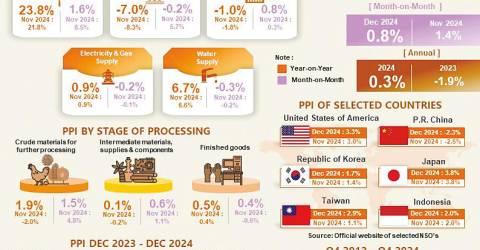
Chief Statistics Malaysia, Datuk Shri Dr. Mohammad Uzir Mahideen said: “The field of agriculture, forestry and fishing recorded a significant increase of 23.8% in December 2024, which shows a strong speed compared to 21.8% in November 2024, due to increasing perennial crops Is (41.9%).
Meanwhile, he connected the mining sector to 7.0%, which is a smaller decline compared to the previous month of negative 8.3%. The decline was mainly due to the extraction of the raw petroleum index, which fell 9.7%.
The manufacturing sector saw a slight decline of 1.0% (November 2024: -1.8%), the major sub -divisions of the manufacture of coke and refined petroleum products declined by 15.5% rapidly and the construction of computers, 1.5 in electronic and optical products 1.5 There was a decrease of %.
On the other hand, the power and gas supply sector recorded an increase of 0.9%, while the water supply area continued to grow by 6.7%.
On the basis of month-by-month, Mohammad Uzir said that in December 2024, PPI continued to grow by 0.8% in local production, compared to 1.4% in November 2024. %), Perennial crops are supported by the increase in index (2.1%).
The manufacturing sector performed positively, under the leadership of 0.8%(November 2024: 0.3%), the manufacture of food products (3.2%) and the construction of computers, electronic and optical products (0.7%).
In contrast, the mining area recorded a marginal decline of 0.2% (November 2024: 5.7%), dragged by 2.4% decrease in extraction of natural gas index. In the field of utilities, the power and gas supply sector declined by 0.2%, while the water supply sector declined by 0.3 percent.
“Raw materials for further process index recorded an increase of 1.9% (November 2024: -2.0%), supported by an increase of 2.4% in the index of non-food substances. Mohammad Uzir said that the finished goods index increased 0.5%(November 2024: 0.4%), with the capital equipment index growing by 1.2%.
Meanwhile, he added intermediate material, supply and component index, which increased slightly from 0.1%(November 2024: -0.2%) operated by materials and components for manufacturing index (3.3%).
On a monthly basis, the content of raw materials increased by 1.5%for further process index in December 2024. The intermediate material, supply and component index increased by 0.6%, while the finished goods index recorded an increase of 0.4%.
PPI local production continued to fall by 0.8% in the fourth quarter of 2024, compared to a decline of 0.2% in the third quarter of 2024. The decline was due to mining (-11.0%) and manufacturing (-1.8%) areas. In contrast, agriculture, forestry and fishing sector recorded a significant increase of 19.8%, while water supply and power and gas supply increased by 6.7%and 0.9%respectively.
Meanwhile, based on the quarter-on-quarter, PPI showed a decline of 0.8%, while in the third quarter of 2024, compared to a decrease of 1.6%, Mohammad Uzir said.
In 2024, he increased PPI local production by 0.3% after posting a negative 1.9% in 2023. The inline was specially supported by the positive index of agriculture, forestry and 7.9 % fishing, while 13.8 % compared to negatively 13.8 of double digits %.
Similarly, water supply and power and gas supply areas increased by 6.5% and 0.6% respectively.
However, both mining and manufacturing indices declined by 2.0% and 0.3% respectively.
In December 2024, global crude oil prices continued to rise due to factors such as OPEC+ production cuts, geo -political stress and demand dynamics.
According to Reuters, China’s crude oil imports were affected by the increasing adoption of new energy vehicles (NEVs) and raw value.
These factors contributed to the decline in global oil prices from US $ 78 per barrel in December 2023, US $ 74 per barrel in December 2024.
Meanwhile, Malaysia’s average crude palm oil price (CPO) for December 2024 reached RM 5,119.50 per tonne, which was above RM 5,011.50 per tonne last month.
According to the Malaysian Palm Oil Board (MPOB), the lowest production since March 2024 affected Malaysia’s CPO market dynamics.
A comparison between selected countries showed that the United States productive price index (PPI) increased by 3.3% this month, increasing from 3.0% in November 2024.
The growth was mainly due to the goods of final demand, especially in the energy index.
Japan’s PPI increased by 3.8%, maintained the same speed as last month. This was the highest since June 2023, as the cost continued to increase for transport equipment and beverages and food items.
Factory gate prices for goods produced by the United Kingdom rose 0.1% in December 2024 (November 2024: -0.5%), inspired by high costs for food products and soft decline in coke and sophisticated petroleum products.
The Chinese manufacturer continued to fall by 2.3% in December 2024, which is less than 2.5% in the previous month.
This was the lowest decline of the 27th month producer deflation since August 2024, as Beijing continued its efforts to encourage demand at the end of the year.
Regarding the prices of the current selected commodity of Malaysia, Mohammad Uzir said that “According to the Commodity Market Outlook by the World Bank, the overall commodity outlook for 2025 indicates a trend at a bottom, with a 5% decline in prices.” With, there was a decrease of 2.0% in 2026 in 2026, 2.0% decreased in 2026, “.
“The recession is attributed to factors such as oversupply in energy markets, stabilizing overcapacea and agricultural prices in metals. The US Energy Information Administration (EIA) estimates that global oil production growth will overcome demand, leading to an oversupleid market.
“Consequently, Brent crude prices are expected to decline by an average US $ 74 per barrel in 2025, 8.0% from 2024 and US $ 66 per barrel in 2026.”