
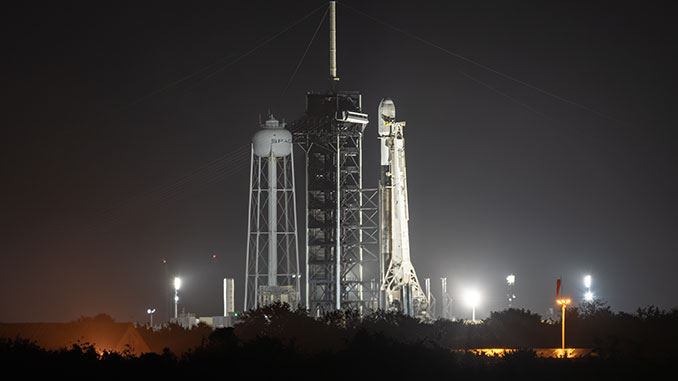
SpaceX is preparing to launch a batch of Starlink satellites early Saturday morning as the Federal Aviation Administration prepares to impose commercial launch restrictions on US airspace.
The company aims to launch the Starlink 10-51 mission at 7:10 a.m. EST (1210 UTC) from Launch Complex 39A at NASA’s Kennedy Space Center. The rocket will fly on a north-easterly trajectory when it lifts off from Florida’s Space Coast.
Spaceflight Now’s live coverage will begin approximately one hour before flight.
SpaceX will launch the mission using a Falcon 9 booster with tail number B1069, which will be its 28th flight. Its previous missions include CRS-24, OneWeb Launch #15, and Eutelsat Hotbird 13F.
Approximately 8.5 minutes after takeoff, B1069 will make an autonomous landing on ‘A Shortfall of Gravitas’, a drone ship located in the Atlantic Ocean off the coast of South Carolina. If successful, it will be the 131st booster landing on this ship and the 531st booster landing ever.
SpaceX intends to deploy 29 Starlink V2 Mini Optimized satellites from the rocket’s upper stage a little more than an hour after launch.
curfew is coming
The mission comes just days before a new, emergency directive issued by the FAA on Thursday prohibits FAA-sanctioned commercial space launches and re-entry between 10 pm and 6 am local time, starting at 6 am EST on November 10.
In the face of the ongoing government shutdown, US Transportation Secretary Sean Duffy, who is also serving as NASA’s acting administrator, also issued a “temporary 10 percent reduction in flights at 40 high-traffic airports across the country.” Those affected airports include Orlando International Airport and Los Angeles International Airport, the nearest major airports to both Cape Canaveral and Vandenberg, respectively.
The impact of the launch curfew will vary depending on the interpretation of “commercial launch”.
SpaceX announced five more Starlink missions between November 10 and November 19 and also plans to launch the Transporter-15 mission on November 11. After a scrub Thursday night, United Launch Alliance’s next attempt to launch the ViaSat-3 F2 mission will also fall after the FAA’s launch ban goes into effect.
SpaceX has some leeway to alter the launch timing for its Starlink missions to fit the FAA’s new mandate. However, missions such as Transporter-15 that want to launch payloads into Sun-synchronous orbit may need to seek special exemptions.
Spaceflight Now also reached out to the FAA for comment, but received an automated response: “Due to funding reductions, the FAA is not responding to routine media inquiries.”
Rocket Lab, on its part, said that it should not face much impact from this decision.
“We can confirm the launch [Launch Complex 1] “They are unaffected by restrictions in New Zealand, as these launches do not operate in U.S. airspace. We also expect minimal impact on launches from LC-2 in Virginia,” the company said.


