

Shortly before sunrise on August 15, step outside to catch a conjunction of two bright planets just over the eastern horizon: Mercury and Jupiter. Credit: Stellarium
Friday, August 14
Mars stands within 1° of the open cluster M35 in the early-morning sky of the 14th. Both are located at the feet of Gemini the Twins, after Mars crossed into the constellation from Taurus just two days ago.
Around 4:45 A.M. local daylight time, you’ll find the Red Planet nearly 30° high in the east, to the far upper right of Castor and Pollux, the heads of Gemini, and to the lower left of Zeta (ζ) Tauri, the tip of the southern horn of Taurus the Bull. Magnitude 1.3 Mars is now just over 2° northwest of 3rd-magnitude Eta (η) Geminorum; it will pass close to this star later in the week.
M35, glowing at magnitude 5.3, is a great target for binoculars or a small telescope. It will appear within the same field of view as Mars, just 1° to Mars’ northeast. Spanning nearly half a degree, roughly the same size as the Full Moon, this open cluster contains more than a hundred young stars. Dozens will pop out even under low magnification, with more becoming apparent as you step up in telescope size. But to capture all its stars, staying at low magnification to give yourself the largest field of view is best.
Closer to sunrise, you can catch Mercury within 0.6° of M44, the Beehive Cluster, in Cancer. That pairing featured in today’s entry in last week’s Sky This Week column.
Sunrise: 6:11 A.M.
Sunset: 7:58 P.M.
Moonrise: 8:20 A.M.
Moonset: 8:59 P.M.
Moon Phase: Waxing crescent (7%)
*Times for sunrise, sunset, moonrise, and moonset are given in local time from 40° N 90° W. The Moon’s illumination is given at 10 P.M. local time from the same location.
Saturday, August 15
Mercury and Jupiter meet in a close conjunction this morning, as Mercury passes just 0.6° north of Jupiter at 5 A.M. EDT. The pair rises an hour before the Sun, some 3° southeast of open cluster M44, which Mercury skimmed past yesterday morning.
Mercury shines at magnitude –1.2 and sits just to the upper right of brighter Jupiter, which is magnitude –1.8. You can easily capture both in binoculars or a telescope, making clear the vast differences in their size. Mercury lies 1.2 astronomical units from Earth — 1 astronomical unit, or AU, is the average Earth-Sun distance of 93 million miles (150 million kilometers). Its disk spans 6” on the sky and appears 85% lit. Jupiter, which lies nearly 6.3 AU from Earth, still spans many times Mercury’s apparent diameter, stretching 31” across and appearing fully lit.
East Coast observers may see the Galilean moon Io transiting the disk as Jupiter rises; the transit ends around 6:20 A.M. EDT, shortly after the planet rises in the Midwest but while it is likely too low to see well in the murky air near the horizon in that time zone. After that, Io lies alone to the planet’s west, while Europa, Callisto, and Ganymede all sit to the east.
Make sure to put away any optics well before the time of sunrise from your location to avoid even accidentally glimpsing the Sun and harming your vision.
By tomorrow morning, the two planets will have separated, putting about 2° between them. Mercury will have also brightened slightly, reaching magnitude –1.3.
Also this morning, Venus reaches greatest eastern elongation at 2 A.M. EDT, standing 46° from the Sun. It isn’t visible before dawn but appears in the western sky after sunset. Look for it just to the upper left of the waxing crescent Moon this evening, slowly sinking as the sky grows darker. Both are located in Virgo, not far from the lovely double star Porrima (Gamma [γ] Virginis). They disappear about 90 minutes after sunset. We’ll return to this region tomorrow, when the Moon and Venus set side by side.
Sunrise: 6:12 A.M.
Sunset: 7:57 P.M.
Moonrise: 9:29 A.M.
Moonset: 9:22 P.M.
Moon Phase: Waxing crescent (14%)
Sunday, August 16
The Moon passes 2° south of Venus at 5 A.M. EDT, although neither is visible at that time. Instead, the Moon rises around midmorning and remains visible until after sunset. By evening, it stands side by side with Venus in the twilit sky, both still within the bounds of the large constellation Virgo.
As the sky grows darker, bright Venus will quickly appear, about 9.5° to the right of the crescent Moon. Observe the planet through a telescope and you will see that it is also a crescent, albeit one that is 48% lit. It reached dichotomy, when it appeared 50% lit, just last week, and will slowly wane even as its apparent angular diameter — now 25” — grows.
To the upper left of the Moon is 1st-magnitude Spica, the brightest star in Virgo. See how soon you can pick it out as twilight fades. This star shines nearly 2,000 times brighter than our own Sun, from a distance of 250 light-years. Although we cannot split it visually, astronomers know it is a close binary system, with two stars just 0.12 AU apart, circling each other closer than the planet Mercury orbits the Sun.
Sunrise: 6:13 A.M.
Sunset: 7:55 P.M.
Moonrise: 10:36 A.M.
Moonset: 9:45 P.M.
Moon Phase: Waxing crescent (22%)
Monday, August 17
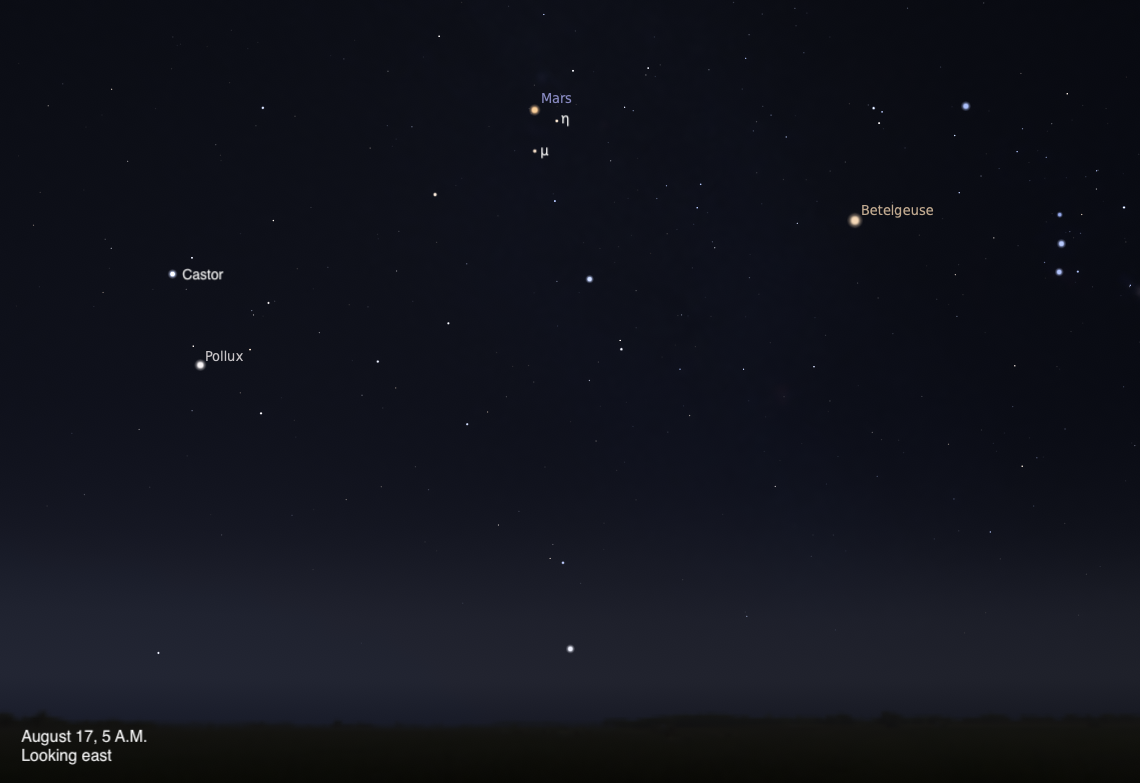
Mars has been making its way eastward through the constellation Gemini, pulling away from open cluster M35 and approaching the two bright stars Eta (η) and Mu (μ) Geminorum. Eta shines at magnitude 3.3 and Mu at magnitude 2.9; both are fainter than 1st-magnitude Mars.
Check out the view in the early-morning sky today, when Mars sits just over 1° north of Eta Gem, to its upper left in the sky as this region rises. By 5 A.M. they are roughly 30° high in the east, easy to pick out shortly before twilight begins to brighten the sky.
This is a great chance to see for yourself our solar system in motion. Eta and Mu are excellent visual anchor points against which to measure the motion of Mars across the sky. Step outside at the same time over the next two days, and you’ll see that by the 19th, Mars has moved to assume a similar position some 1° north of Mu, now standing to that star’s upper left.
Sunrise: 6:13 A.M.
Sunset: 7:54 P.M.
Moonrise: 11:42 A.M.
Moonset: 10:10 P.M.
Moon Phase: Waxing crescent (31%)
Tuesday, August 18
Wait until after about 10 P.M. tonight to begin your deep-sky observing and the Moon won’t be a bother. An excellent target is NGC 6939, an open cluster in Cepheus the King. This cluster is quite compact, about 8’ across, and shines at 8th magnitude. You can locate it in the north late tonight — by 10 P.M. local daylight time, it is some 60° high, to the upper left of Alderamin, Cepheus’ alpha star. From this magnitude 2.5 sun, slide just under 6° southwest to land on the cluster.
Although NGC 6939 is an open cluster and these groups are young, it’s one of our galaxy’s older such clusters, at some 1 billion to 2 billion years old. It can be viewed in binoculars, but larger apertures will pull out its stars as points, rather than simply showing a dim, amorphous glow.
NGC 6939 also has a famous neighbor — some ⅔° to its southeast (and 2.1° southwest of magnitude 3.4 Eta [η] Cephei) is NGC 6946, a face-on spiral known as the Fireworks Galaxy. Glowing at magnitude 8.9, this galaxy has had at least 10 supernovae pop off within it over the last century! Compare that with our own galaxy, which sees about one every century.
Spanning roughly 10’, NGC 6946 can be a bit challenging because its light is spread out over a relatively large area, making it appear dim. It’s also located behind a swath of light-absorbing dust within our own galaxy. Even so, it can be found in binoculars and it will show up as a faint, relatively detail-less glow in smaller scopes. In larger telescopes (11 inches), the brighter core and fainter arms become distinct, and grow even more detailed as you scale up your aperture.
Both objects show up well in astrophotos, making this a popular pair for imagers to target.
Sunrise: 6:14 A.M.
Sunset: 7:53 P.M.
Moonrise: 12:47 P.M.
Moonset: 10:38 P.M.
Moon Phase: Waxing crescent (41%)
Wednesday, August 19
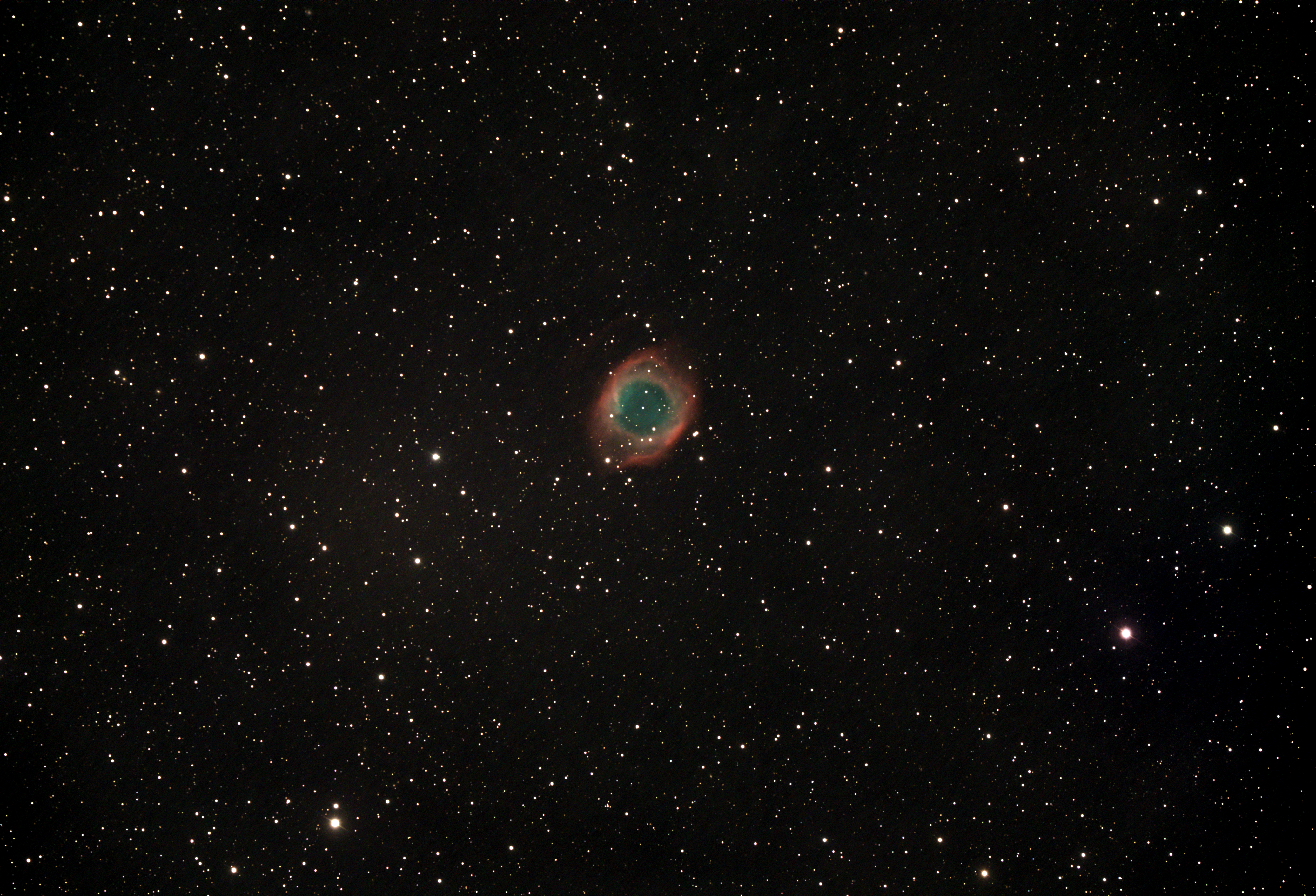
First Quarter Moon occurs at 10:46 p.m. EDT. The Moon is up nearly all evening, not setting until after 11 P.M. local daylight time, so our viewing options are a bit more limited, with only a short dark window. But if you’re willing to stay up late, you’re in luck: NGC 7293, the Helix Nebula, is highest around 1 A.M. local daylight time, when it stands some 30° above the southern horizon. It is also cataloged as Caldwell 63.
Located in Aquarius, the Helix is a lovely circular planetary nebula generated as well as lit up by the dying star at its center. Although it is 8th magnitude — quite bright for a planetary — its inner portion covers some 16’ of sky, making it one of the larger planetary nebulae we know. It also means that (like the Fireworks Galaxy yesterday) its light is spread out over a larger area, making its overall surface brightness low. But that doesn’t mean it can’t be seen — in fact, it can still be caught in binoculars or a small scope. On a very dark night (and if you have very good eyesight), you may even be able to see it without any optical aid! It’s in a patch of sky in southwestern Aquarius devoid of bright stars, but you can hop some 7.8° southwest of 3rd-magnitude Skat (Delta [δ] Aquarii) to find it. For a fainter but closer signpost, use 5th-magnitude Upsilon (υ) Aqr — it’s just 1.2° west of this star.
If you’ve got a large scope, screw in a nebula filter to bring out more detail, including brightness variations along the edges of its ring.
Sunrise: 6:15 A.M.
Sunset: 7:51 P.M.
Moonrise: 1:52 P.M.
Moonset: 11:11 P.M.
Moon Phase: First Quarter
Thursday, August 20
The waxing gibbous Moon dominates the evening sky, located in Scorpius. You’ll find it close to the Scorpion’s red giant heart, 1st-magnitude Antares. Watch it close in as the hours tick by — our satellite will pass just 0.6° south of this star at 1 A.M. EDT on the 21st, visible from the western half of the U.S.
An hour after sunset, the pair is roughly 20° high in the south. Zoom in on the Moon with a telescope and seek out the large, flat-floored crater Plato, located in the lunar north, along the northern rim of Mare Imbrium (the Sea of Rains). The crater should stand out clearly as a dark spot along the rugged rim of Imbrium.
With the crater floor in your eyepiece, watch as the shadows streaking across it shorten as the Sun rises higher in the lunar sky. Over Plato, the terminator (the line dividing lunar night and day) is moving at nearly 6 mph (9.7 km/h), and you can notice changes in the shadows here in just a few hours.
Although Plato’s broad floor may appear flat and featureless at first, look closely — there are several smaller craterlets carving out material here, like someone took an ice cream scoop to the Moon’s surface. These came after Plato’s initial formation, which was more than 3 billion years ago.
Once you’re through with Plato, take a moment to skim just a bit southeast along Imbrium’s edge. Not far from Plato, there’s a straight slash mark, this time like someone gouged out a piece of the mountainous terrain with a palette knife. This is called Vallis Alpes, or the Alpine Valley, and it cuts through (perhaps predictably) the Montes Alpes, or lunar Alps.
Sunrise: 6:16 A.M.
Sunset: 7:50 P.M.
Moonrise: 2:54 P.M.
Moonset: 11:50 P.M.
Moon Phase: Waxing gibbous (60%)
Friday, August 21
The Moon passes 0.6° south of Antares at 1 A.M. EDT, although it will have set before this for the eastern half of the U.S. Nonetheless, this part of the country will still see our satellite closely approaching the star before the pair sets.
Once that happens, turn your gaze southeast to find Saturn already some 30° high, shining so brightly it’s easy to pick out among the dim stars populating this region. You’ll want a telescope — even a small one will do — to view the planet’s lovely ring system, which stretches some 43” from end to end. That’s more than twice the planet’s apparent diameter, which is currently 19”. The rings are showing off their southern side, and the southern pole of Saturn is visible as well.
Now look just northeast of the planet — you should be able to identify Titan, Saturn’s largest moon, glowing at mid-8th magnitude less than an arcminute away. If you come back tomorrow morning, this moon will have slid westward in its orbit, standing northwest of Saturn the morning of the 22nd. It takes about 16 days in total for Titan to complete a full orbit.
If you have dark skies and a larger scope, you may also spot 10th-magnitude Rhea, Dione, and Tethys near Saturn as well. Around 2 A.M. EDT, all three are east of the planet, with Dione to the northeast (but closer in than Titan), Tethys to the east, and Rhea to the southeast. Over the next few hours, you can watch Dione moving west at a much faster pace than Titan — observers in the Central time zone and areas west of this will see Dione skim just north of Saturn’s pole around 5 A.M. CDT.
Sunrise: 6:17 A.M.
Sunset: 7:48 P.M.
Moonrise: 3:52 P.M.
Moonset: —
Moon Phase: Waxing gibbous (69%)
Alison Klesman is senior editor of Astronomy magazine. She holds a Ph.D. in astronomy and has studied a variety of topics, from minor planets to supermassive black holes.
