
AI agents grapple with tasks that require interacting with the live web – fetching a competitor’s pricing page, extracting structured data from a JavaScript-heavy dashboard, or automating multi-step workflows on a real site. Tooling is fragmented, requiring teams to tie together disparate providers for search, browser automation, and content retrieval.
Tinyfish, a Palo Alto-based startup that previously shipped a standalone web agent, is launching what it describes as an end-to-end infrastructure platform for AI agents working on the live web. This launch introduces four products integrated under a single API key and one credit system: web agent, web search, Web browserAnd web fetch.
what is tinyfish shipping
Here’s what each product does:
- web agent – Performs autonomous multi-step workflows on real websites. The agent navigates sites, fills out forms, clicks through the flow, and returns structured results without the need for manually scripted steps.
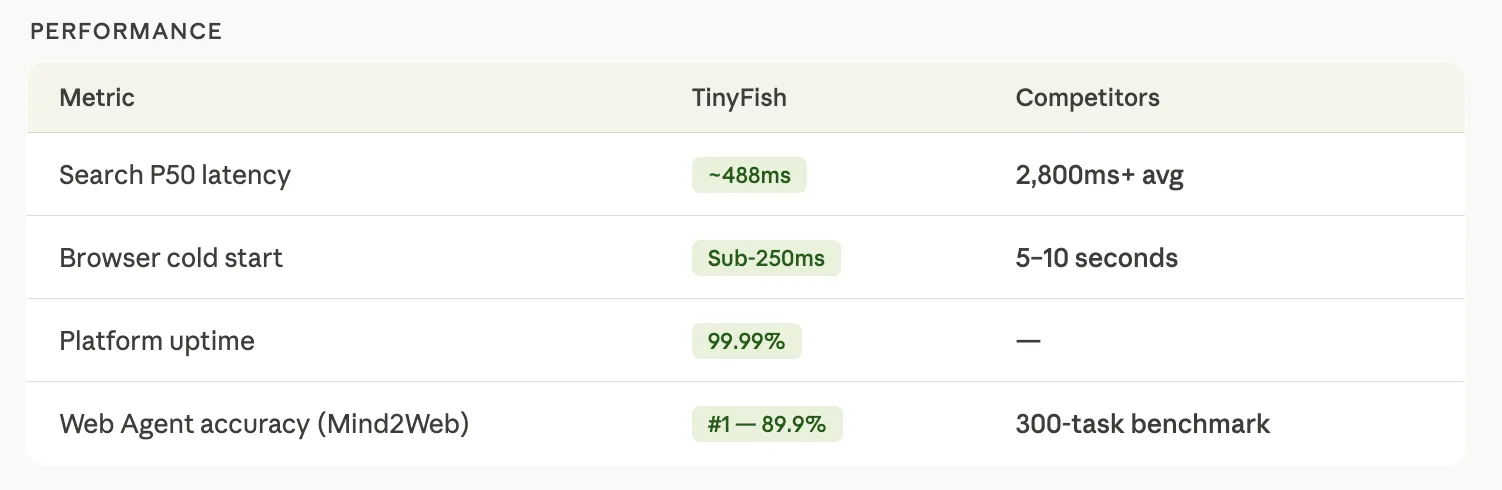
- web search – Returns structured search results as clean JSON using a custom Chromium engine, with a P50 latency of approximately 488ms. Competitors in this sector use an average of more than 2,800ms for the same operation.
- Web browser – Provides managed stealth Chrome sessions through the Chrome DevTools Protocol (CDP), with a cold start of less than 250ms. Contestants usually take 5-10 seconds. The browser includes 28 anti-bot mechanisms built in at the C++ level – not through JavaScript injection, which is the more common and more detectable approach.
- web fetch – Converts any URL to clean Markdown, HTML, or JSON with full browser rendering. Unlike the native fetch tools built into many AI coding agents, TinyFish Fetch removes irrelevant markup – CSS, scripts, navigation, ads, footers – and returns only the content the agent needs.
Token problem in agent pipelines
One of the frequent performance problems in agent pipelines is context window pollution. When an AI agent uses a standard web fetch tool, it typically pulls the entire page – including thousands of tokens of navigation elements, ad code, and boilerplate markup – and puts it into the model’s context window before accessing the actual content.
TinyFish Fetch solves this by rendering the page in the full browser and returning only the clear text content as Markdown or JSON. The company’s benchmarks show CLI-based operations using about 100 tokens per operation, while routing the same workflow on MCP uses about 1,500 tokens – an 87% reduction per operation.
Beyond token counting, there is one architectural difference worth understanding: MCP operations return output directly to the agent’s context window. The TinyFish CLI writes output to the file system, and the agent only reads what it needs. This keeps the context window clean in multi-step tasks and enables composability via native Unix pipes and redirects – something that is not possible with sequential MCP round-trips.
On complex multi-step tasks, TinyFish reports 2× higher task completion rates using CLI+ skills compared to MCP-based execution.
CLI and Agent Skills System
TinyFish is shipping two developer-facing components with API endpoints.
CLI is installed with Single Order:
npm install -g @tiny-fish/cliThis gives the terminal access to all four endpoints – Search, Fetch, Browser and Agent – directly from the command line.
agent skills There is a Markdown instruction file (SKILL.md) that teaches AI coding agents – including CloudCode, Cursors, Codex, OpenClave, and OpenCode – how to use the CLI. install it with: :
npx skills add https://github.com/tinyfish-io/skills --skill tinyfishOnce installed, the agent learns when and how to call each TinyFish endpoint without manual SDK integration or configuration. A developer can ask their coding agent to “get competitive pricing from these five sites”, and the agent autonomously recognizes the TinyFish skill, calls the appropriate CLI commands, and writes structured output to the file system – without the developer having to write integration code.
The company also notes that MCP remains supported. The situation is that MCP is suitable for search, while CLI+ skills are the recommended path for heavy-duty, multi-step web execution.
Why integrated stack?
Tinyfish built the search, fetch, browser, and agent completely in-house. This is a meaningful difference from some competitors. For example, BrowserBase uses Exa to power its search endpoint, which means that that layer is not proprietary. Firecrawl provides search, crawl, and an agent endpoint, but the agent endpoint has reliability issues on many tasks.
The infrastructure argument is not just about avoiding vendor dependency. When each layer of the stack is owned by the same team, the system can optimize for a single outcome: whether the task is completed. When Tinyfish’s agent succeeds or fails using its own search and fetch, the company gets an end-to-end signal every step of the way – what was searched for, what was fetched, and exactly where the failure occurred. Companies whose search or fetch layer runs on third-party APIs do not have access to this signal.
There is also a practical cost that teams who integrate multiple providers face. Search returns a page that the fetch layer cannot render. Fetch returns content that the agent cannot parse. The browser drops the context between session steps. The result is custom glue code, retry logic, fallback handlers, and validation layers – engineering work that adds up. An integrated stack removes the component boundaries where these failures occur.
The platform also maintains session consistency across different stages: same IP, same fingerprint, same cookies throughout the workflow. Different devices working independently appear as multiple unrelated clients to a target site, increasing the likelihood of detection and session failure.
key metrics



key takeaways
- TinyFish moves from a single web agent to a four-product platform – web agent, web search, web browser, and web fetch – all accessible under one API key and one credit system, eliminating the need to manage multiple providers.
- The CLI + Agent Skills combination lets AI coding agents use the live web autonomously – install once and agents like Cloud Codes, Cursors, and Codex automatically know when and how to call each Tinyfish endpoint, without any manual integration code.
- CLI-based operations generate 87% fewer tokens per task than MCP, and write output directly to the file system instead of dumping it into the agent’s context window – keeping the context clean in multi-step workflows.
- Each layer of the stack – search, fetch, browser, and agent – is built in-house, providing end-to-end signals when a task succeeds or fails, a data feedback loop that can’t be replicated by assembling a third-party API.
- TinyFish maintains the same session identities throughout the workflow – same IP, fingerprint and cookies – while different tools appear to target sites as multiple unrelated clients, increasing the risk of detection and failure rates.
launch
Tinyfish.ai offers 500 free steps with no credit card required. The open-source cookbook and skill files are available at github.com/tinyfish-io/tinyfish-cookbook, and the CLI documentation is available at docs.tinyfish.ai/cli.
Comment: Thank you to TinyFish leadership for supporting this article and providing details.


