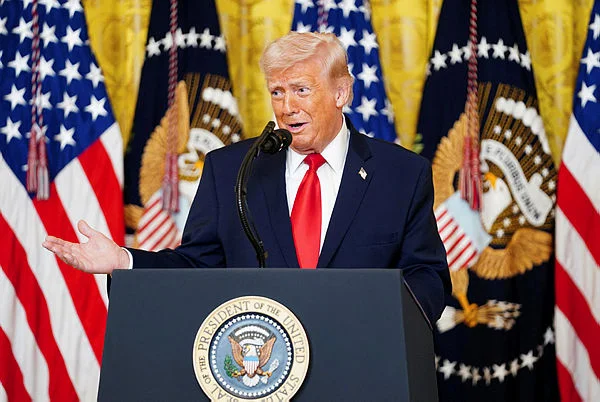
US President Donald Trump on Saturday said the United States attacked military targets at a strategic Iranian outpost in the Persian Gulf and warned that Tehran could also damage oil infrastructure if it continues to disrupt energy flows through the Strait of Hormuz, escalating a two-week conflict in the region.
Trump said in his post on Truth Social: “Not long ago, at my direction, the United States Central Command carried out one of the most powerful bombing attacks in the history of the Middle East, and completely destroyed every military target in Iran’s crown jewel, Kharg Island.”
He said, “Our weapons are the most powerful and sophisticated the world has ever known, but out of decency, I have decided not to destroy the oil infrastructure on the island.”
The strategic island, which handles almost all of Iran’s crude exports, has so far been largely avoided by both the US and Israel.
Trump administration officials have reportedly suggested that capturing Kharg Island is a possible option.
In another post, Trump said, “Iran’s plan was to take over the entire Middle East and completely destroy Israel. Just like Iran, those plans are now over!”
In response, Iran threatened to attack oil targets linked to the US.
In a statement quoted by Iranian media, the military’s al-Anbiya central headquarters warned that oil and energy facilities belonging to companies cooperating with the US “will be immediately destroyed and turned into ashes” if Iran’s energy infrastructure was targeted.
Update: Iranian media, Fars News Agency, reported that there was no damage to its oil infrastructure on Kharg Island. However, this has not been confirmed yet by the country’s army.
Meanwhile, Qatar’s Defense Ministry said in two separate statements on Saturday that its forces had successfully intercepted a missile attack targeting the country, AFP News reported.
Hamas said in a separate statement on Saturday, The Iran-backed terrorist group called on Tehran to stop attacks on neighboring countries.
Hamas said, “While reaffirming the right of the Islamic Republic of Iran to respond to this aggression by all available means in accordance with international norms and laws, the movement calls on Iran’s brothers to refrain from targeting neighboring countries.”
market implications
These headlines are likely to intensify ongoing volatility in oil, with prices likely to rise during early Asian hours on Monday if Tehran deepens the conflict by attacking energy infrastructure owned by oil companies that cooperate with the US in the region.
WTI Oil FAQs
WTI oil is a type of crude oil that is sold in international markets. WTI stands for West Texas Intermediate, one of three major types of crude including Brent and Dubai crude. WTI is also called “light” and “sweet” due to its relatively low gravity and sulfur content, respectively. It is considered a high quality oil that can be easily refined. It is sourced in the United States and distributed through the Cushing Hub, considered the “Pipeline Crossroads of the World”. It is a benchmark for the oil market and the price of WTI is often quoted in the media.
Like all assets, supply and demand are the key drivers of the price of WTI oil. Thus, global growth can be a driver of rising demand and vice versa for weak global growth. Political instability, war and sanctions can disrupt supplies and impact prices. Decisions by OPEC, a group of major oil producing countries, are another major price driver. The value of the US dollar affects the price of WTI crude oil, as oil is primarily traded in US dollars, thus a weaker US dollar can make oil more affordable and vice versa.
The weekly oil inventory reports published by the American Petroleum Institute (API) and the Energy Information Agency (EIA) influence the price of WTI oil. Changes in inventory reflect fluctuations in supply and demand. If the data shows a decline in inventories it could indicate increased demand, sending oil prices higher. Higher inventory may reflect increased supply, driving prices down. The API report is published every Tuesday and the EIA report the next day. Their results are generally similar, coming within 1% of each other 75% of the time. EIA data is considered more reliable because it is a government agency.
OPEC (Organization of the Petroleum Exporting Countries) is a group of 12 oil producing countries that collectively set production quotas for member countries in twice-yearly meetings. Their decisions often impact WTI oil prices. When OPEC decides to reduce quotas, it could tighten supply, causing oil prices to rise. When OPEC increases production it has the opposite effect. OPEC+ refers to an expanded group that includes ten additional non-OPEC members, the most notable of which is Russia.