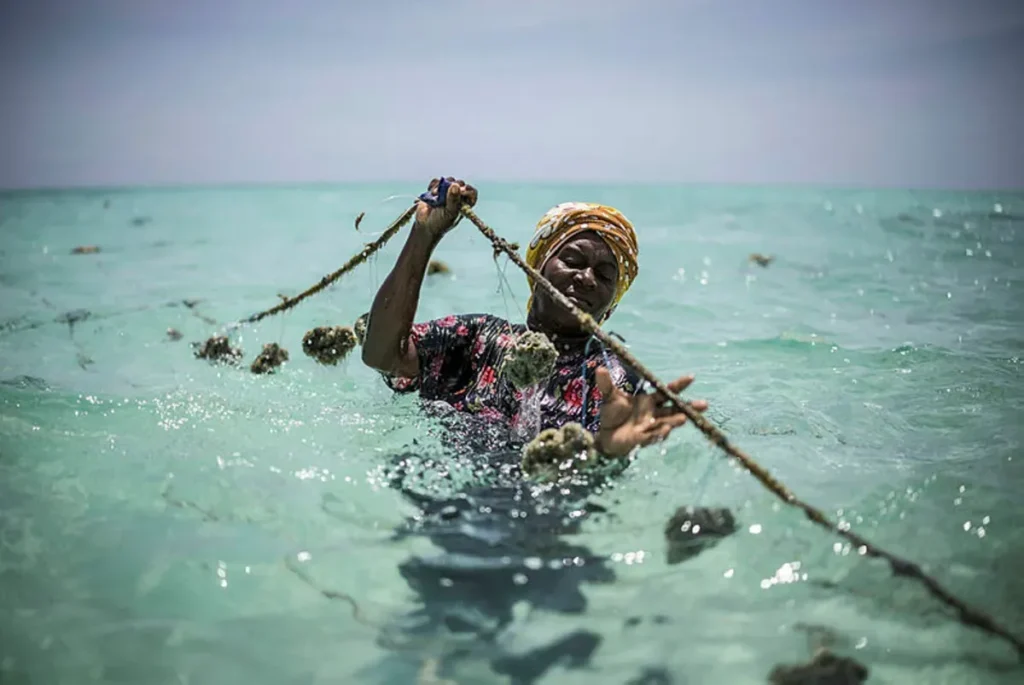
Women in Zanzibar are turning to sponge farming as climate change destroys seaweed, generating eco-friendly income and restoring reefs
Zanzibar: Every day around 10 a.m., women wearing hijabs and loose long dresses wade through Zanzibar’s turquoise shallow tides to tend their sponge farms – a new lifeline after climate change replaced their former work.
Rising ocean temperatures, overfishing and pollution have continually degraded the marine ecosystem around the island, undermining a major source of income for the local people of Jambiani village, who have long depended on seaweed farming.
Instead, they have turned to sponge farming under a project set up by Swiss NGO Marine Cultures.
Hot temperatures have killed seaweed and caused fish stocks to decline, forcing many fishermen to abandon work, said project manager Ali Mahmoudi.
But sponges, which provide shelter and food to sea creatures, thrive in warm waters.
They are also attractive as an organic personal care product, used for skin exfoliation. Depending on the size, they can cost up to $30 each and a farm can contain up to 1,500 sponges.
From the shore, black sticks can be seen sticking out of the water holding rows of sponges.
“I was surprised to learn that sponges exist in the sea,” Nasiri Hassan Haji, 53, told AFP.
The mother of four once farmed seaweed, describing the work as labor-intensive with low returns.
In 2009, Marine Cultures launched a pilot farm with widowed women in Jambiani to test its potential in the archipelago, where more than a quarter of the 1.9 million population live below the poverty line.
As demand for eco-friendly products increases, the market has seen steady growth, with the US National Oceanic and Atmospheric Administration estimating the natural sponge market to be worth $20 million in 2020.
“It has changed my life, I have been able to build my own house,” said Shamsa Abbasi Suleman, 53, smiling proudly.
Several other women have now joined the co-operative to expand the project, but it was not always smooth.
“At first I was afraid to go in because I couldn’t swim. Many people discouraged me, saying the water was too high and I would die,” Haji said.
Thanks to an NGO programme, he learned to swim at the age of 39.
Sponges restore coral reefs
As well as making money for local people, sponges are also beneficial for the marine environment.
Studies show that the sponge’s skeletal structure aids in carbon recycling within coral reef ecosystems, while its porous body naturally filters and purifies seawater.
An estimated 60 percent of the world’s marine ecosystems have been destroyed or are being used unsustainably, according to the United Nations, which warns that “the ocean is in deep crisis”.
Sponges are also known to help restore coral reefs, which support 25 percent of marine life and are currently endangered.
“What attracted me to it is the fact that we’re not destroying the environment,” Haji said. – AFP
Post View: 1