UPDATE: January 6, 1:25 PM EST (1825 UTC): Corrected some launch complex position information for accuracy.
A new orbital launch site is ready at Vandenberg Space Force Base (VSFB) in California.
On Monday, the Department of the Air Force published a new request for information from launch providers to determine the level of interest in becoming the southernmost launch complex on the Western Range.
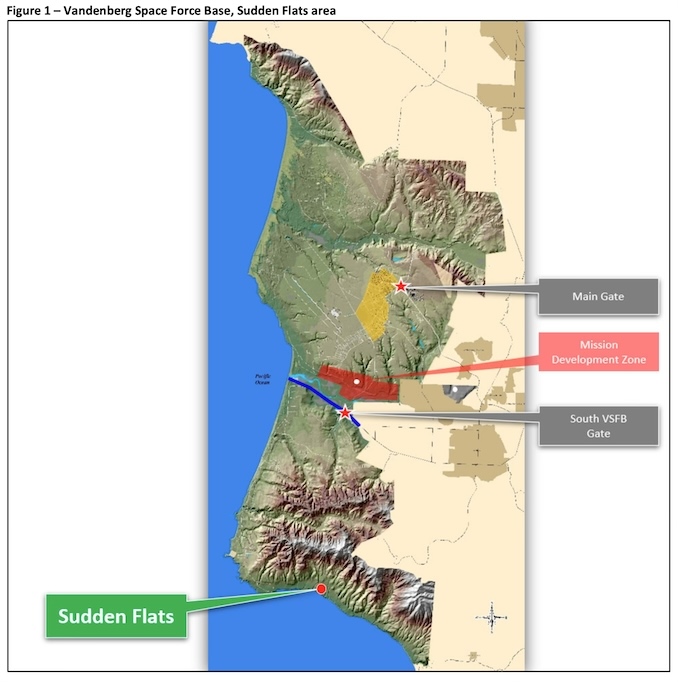
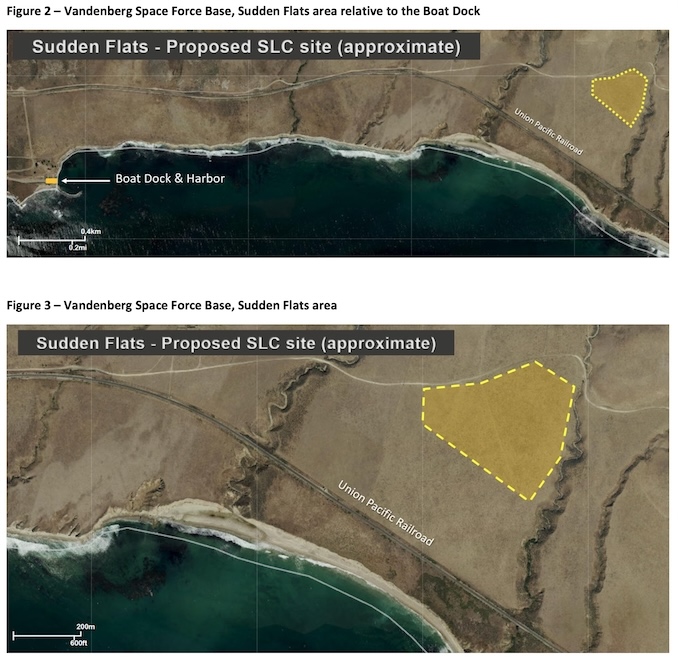
The space, which will be designated Space Launch Complex 14 or SLC-14, is being set aside for orbital rockets in the heavy or super-heavy vertical launch class. The government defines “heavy” as a payload capacity between 20,000–50,000 kg (44,092–110,231 lb) and anything over 50,000 kg as “super-heavy”.
“Because of the unique characteristics of SLC-14 and the goal of maximizing assured access to space in support of national security objectives, the Department of the Air Force (DAF), the United States Space Force (USSF), and Space Launch Delta 30 (SLD 30) are committed to ensuring the best use of this asset,” the RFI said.
Vandenberg currently hosts various launch providers, spread across several pads:
- SLC-2 – Firefly Aerospace, Alpha Rocket
- SLC-3 – United Launch Alliance, Vulcan rocket (under development)
- SLC-4E – SpaceX, Falcon 9 rocket
- SLC-5 – Phantom Space, Daytona rocket (undeveloped; environmental assessment completed)
- SLC-6 – SpaceX, Falcon 9 and Falcon Heavy rockets (under development)
- SLC-8 – Government-owned, multi-use pad (most recently used by Northrop Grumman’s Minotaur 4 rocket on April 16, 2025)
- SLC-9 – Undeveloped (A draft environmental assessment document dated February 2025 references Blue Origin in the “reasonably anticipated projects” table, but a spokesperson for SLD 30 said on January 6 that Blue Origin currently has no grant or lease for property in the VSFB)
- SLC-576E licensed to Long Wall (formerly ABL Space Systems)
One of the requirements listed in the RFI includes what the government calls “highest technological maturity”. It added that for a launch provider’s bid to be taken seriously, it would have to prove it could “commence operations within approximately five years of the issuance of the actual property grant (lease).”
According to the RFI, “the provider with a more technologically mature vehicle is clearly better positioned to quickly begin operations on the SLC-14.” “To demonstrate the ability to meet this criteria, respondents must submit a schedule of anticipated milestones proposing how the intended vehicle can become operational on SLC-14 within five years of the actual property grant (lease) issuance.”
SLD30 said in this RFI that it not only wants to bring new launch capability to the California coastline, but also ensure it blends well with existing missions at Vandenberg.
“To demonstrate the ability to meet this criteria, respondents should provide information on projected launch rates, mass to orbit per launch, amount of fuel required, explosive arc and hazardous area (including working or approved blasting site maps), mitigation options for anticipated impacts to neighboring operations, and transportation routes as well as any modifications needed to existing VSFB infrastructure to support operations (e.g., ports, roads, utilities, processing),” the RFI states.
Interested parties will also have to be able to comply with regulations set by the National Environmental Protection Act (NEPA). The government noted that since the land for SLC-14 is currently undeveloped, an environmental impact statement and record of decision will also need to be prepared before construction can begin.
The government will have to reply by February 12.
Who is in dispute?
Many US launch providers have rockets that qualify in the heavy to super-heavy classification either currently launching or in development. But to increase the diversity of rockets flying from Vandenberg, SLD30 is primarily looking for options that don’t currently exist in the VSFB.
Given all the requirements and the state of play on the orbital launch front, one of the contenders will probably be SpaceX with its Starship-Super Heavy rocket. The company is scheduled to launch the latest version of the rocket, called Version 3, in early 2026.
In 2025, SpaceX also received approval from the Department of the Air Force to proceed with the overhaul of SLC-37 at Cape Canaveral Space Force Station (CCSFS) in Florida, which will house two Starship launch towers. It’s unclear whether SpaceX were to make a play for SLC-14, whether it would also have two towers like SLC-37 or its Starbase site in Texas.
We have received approval to develop Space Launch Complex-37 for Starship operations at Cape Canaveral Space Force Station. Construction has started.
With three launch pads in Florida, Starship will be ready to support U.S. national security and Artemis goals as the world… pic.twitter.com/USgwNzwK8L– SpaceX (@SpaceX) 1 December 2025
Blue Origin is another potential contender for launch real estate. While they have a currently undeveloped slot in SLC-9 for their New Glenn rocket, in late November, the company unveiled plans for a super-heavy lift version called New Glenn 9×4, which will have nine BE-4 engines on the booster and is designed to carry more than 70 metric tons (154,324 lb) to low Earth orbit.
Another company that may make efforts in the space is Relativity Space. Like both Blue Origin and SpaceX, their heavy lift rocket, the Terran R, is also designed to have a reusable first stage booster and is expected to deliver up to 23,500 kilograms (51,809 lb) to low Earth orbit in its reusable configuration.
Relativity is in the midst of converting Launch Complex 16 at CCSFS from its previous design to support the smaller Terran 1 rocket, which flew once before being retired. The goal is to have an inaugural flight of Terran R from Florida before the end of 2026.
The November Terran R program update has arrived. Progress is being made in the development of hardware and infrastructure in the areas of design, manufacturing, testing and launch.
🏭 On the floor, teams completed all perimeter welds on the first stage tanks and completed acceptance testing on the second stage… pic.twitter.com/wKCCymollu
– Relativity Space (@relativityspace) 9 December 2025
Both Firefly Aerospace and Rocket Lab also have upcoming rockets, called Eclipse and Neutron, which have dedicated pads on Wallops Island, Virginia. However, because they are classified as medium lift rockets – supporting between 2,000–20,000 kg (4,409–44,092 lb) – they are not in contention for the SLC-14.
all part of the plan
SLD 30 is undergoing a significant update as part of an overhaul called the Spaceport of the Future. It is an investment of taxpayer dollars combined with creative reengineering of the infrastructure needed to support the launch rate anticipated for 2036.
SLD 30’s commander, Col. Jim Horn, spoke about the venture with SLD 45’s commander, Col. Brian Chatman in Florida, and Col. Eric Zrebniski, U.S. Space Force’s Program Executive Office for Assured Access to Space. AATS, which operates under the USSF’s Space Systems Command, is responsible for the acquisition, development, and management of the national security space launch program, along with other acquisition programs.
“Spaceport 2036 is exactly what we call it […] A set of activities that we have today, but much more seamlessly integrated, automated, meeting the requirements that we’re giving to Colonel Zarybinski, are parallel operations and simultaneous launches and things like that,” Horn said during a reporter roundtable at the 2025 Spacepower conference hosted by the Space Force Association in Orlando, Florida.
“So, we’re building the infrastructure to continue to have that capability and then help accommodate the stresses that we’re seeing. We’re paying off a huge technical debt that we’ve accumulated over many decades in the infrastructure. We haven’t really made a significant change to the launch infrastructure since the ’60s, when we built it for the space race.”
During a panel at the conference, Horn said $861 million is currently being invested in the VSFB for the Spaceport 2036 initiative. This is going towards things like upgrading roads, ports, electric grid, gate capacity and more as they prepare for a launch cadence of between 150 and 200 flights annually.
Horn said part of the modernization of a more commercially operated spaceport are initiatives like collecting indirect fees from launch providers. He said SLD30 publishes an annual report for its stakeholders to show what has been charged and how the funds are being used.
Among the Space Force Guardians at VSFB, Horn said there are about 40 people who are responsible for assessing the environmental impacts of decisions made at the site to help ensure a balance between advancement and maintaining good stewardship of the land.
“We have 16 endangered species at Vandenberg, the most of any other installation, and it is an extremely sensitive environmental area,” Horn said. “Despite what you may hear to the contrary, we have strong partnerships with many people. Our environmental analysis is comprehensive and the safeguards we have put in place have been incredibly successful.
“We have a very rich, vibrant environment and we’ve been doing that for decades. None of that has changed. It’s just that as we increase our throughput, we have to be sensitive to those impacts and they do an incredible amount of work day in and day out.”