Bhutan’s latest Bitcoin transfer has revived one of the market’s more unusual sovereign-BTC questions: Is the kingdom still mining, or is it now mainly selling from older reserves? Arkham said wallets linked to Bhutan transferred another $44.44 million in BTC, bringing total transfers from those addresses to $72.3 million in 24 hours, while noting that the last flow linked to Bhutan was more than $100,000 seen a year ago.
Those details are what turned a routine wallet movement into a big story. If the identified wallet is no longer receiving new mining rewards, the obvious explanation is that Bhutan’s state-backed mining operations have slowed or stopped. Arkham pushed that line directly, asking whether Bhutan had stopped mining after repeatedly highlighting long gaps in outbound transfers and visible flows.
The sales pattern itself is not new. Arkham had flagged another $27.8 million BTC transfer a day earlier and said Bhutan had also transferred $11 million last week, with roughly the same amount sent to an address previously used in similar transactions. According to Arkham, Bhutan has periodically sold portions of its Bitcoin at a clip of about $5 million to $10 million, particularly with the active phase beginning in mid-to-late September 2025.
Has Bhutan stopped mining Bitcoin?
Bhutan just withdrew $44.44M BTC from its accounts. Bhutan has transferred $72.3M BTC from its address in the last 24 hours.
The last >$100K BTC flow to Bhutan was 1 year ago. Has Bhutan stopped mining Bitcoin? https://t.co/IhcGDMRH0t pic.twitter.com/qvQuKXXoaU
– Arkham (@arkham) 18 March 2026
Has Bhutan Really Stopped Bitcoin Mining?
Still, on-chain proof by itself does not resolve the question. Bhutan kept its mining activities secret for years. This only became public through investigations related to the bankruptcies of Celsius and BlockFi. That history leaves open a more cautious interpretation: DHI is still operating under the radar and sending new mining rewards to new, as-yet-unknown wallets. In other words, the lack of inflows to known addresses does not prove that mining has ended.
Another possible explanation is seasonality. Bhutan’s mining model is deeply linked to hydropower, and the country’s electricity production is highly dependent on weather patterns and the time of year. During the winter months, power generation can drop significantly due to low rainfall and low water levels. In contrast, in summer, Bhutan produces a large amount of energy surplus. In that case, the absence of fresh flows may reflect a seasonal decline in the amount of surplus electricity available for mining.
This distinction matters because Bhutan has never offered Bitcoin as a short-term trade. In a public statement attached to the Gelephu Mindfulness City, the country said, “Bitcoin is not being kept as an object of speculation. It is being kept aside for purpose. It is not an experiment. It is a commitment.” Those lines suggested a strategic, state-level approach to Bitcoin linked to Bhutan’s broader economic and energy model rather than opportunistic treasury management.
Still, the recent influx raises legitimate questions about what that strategy now looks like in practice. If Bhutan is still mining, it can only do so through wallets that are no longer publicly associated with the operation. If that is not the case, the current transfer looks less like portfolio rotation and more like continued reserve monetization from reserves accumulated over the past years of water-powered mining.
The deeper issue is not just whether Bhutan sold another tranche of BTC or not. That’s because one of the most visible sovereign Bitcoin holders in the world has become hard to read precisely when its visible wallets are showing distributions, not accumulations. Until new inflows emerge or new wallet infrastructure is identified, the question raised by Arkham will remain open: not whether Bhutan is moving Bitcoin, but whether it is still producing it.
At press time, BTC traded at $70,394.
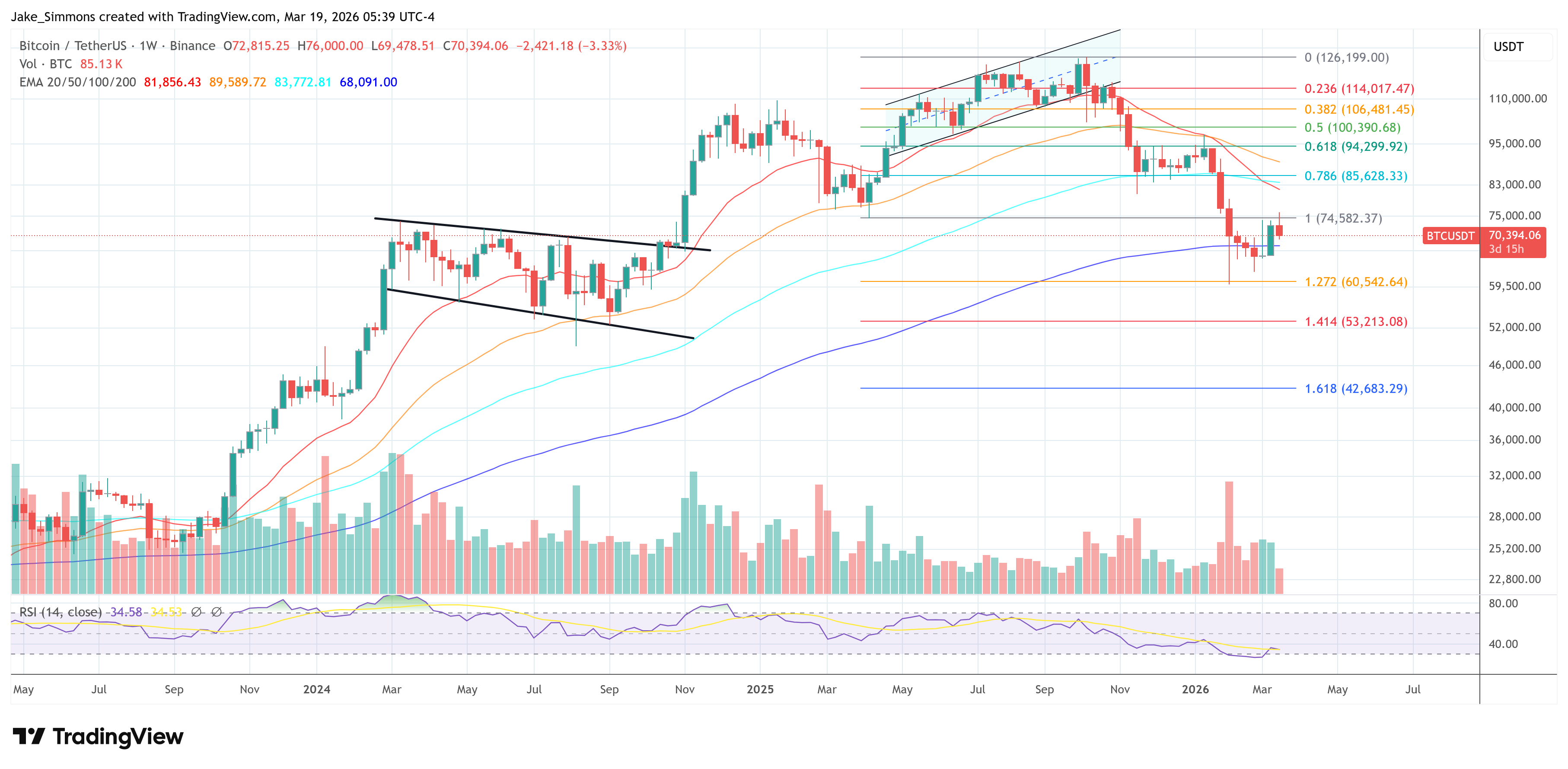
Featured image created with DALL.E, chart from tradingview.com
editorial process Focused on delivering thoroughly researched, accurate and unbiased content for Bitcoinists. We adhere to strict sourcing standards, and each page undergoes diligent review by our team of top technology experts and experienced editors. This process ensures the integrity, relevance and value of our content to our readers.