
From April 2026 issue
This symbiotic binary system consists of two separate stars locked together.

Credit: X-ray: NASA/CXC/SAO; ESA/XMM-Newton; Optical HST: NASA/ESA/STScI; Optical Ground: Deep Space Remote Observatories/B. फेरा और एस. Mandel; ESO/VLT
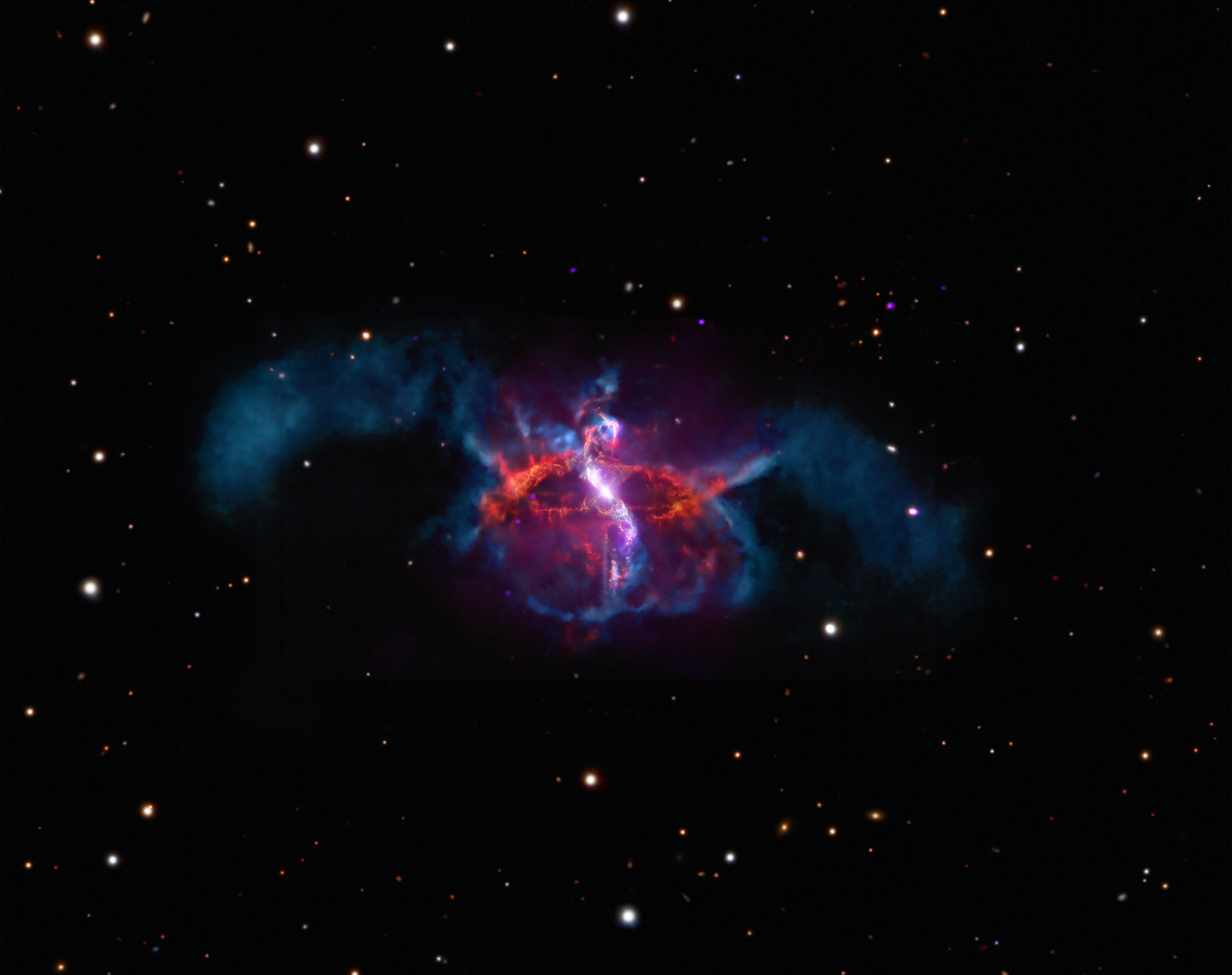
As odd couples go, it’s hard to beat the stellar pair at the heart of Aquarius. This symbiotic binary system consists of a cool red giant and a luminous white dwarf locked in a 44-year elliptical orbit. This giant star pulsates on a period of about 390 days, causing changes in temperature and brightness. It has only a weak grip on its swollen outer layers, which allows the white dwarf to swallow some of this material as it gets closer to the two. The free hydrogen forms an accretion disk around the white dwarf. When enough gas accumulates, it triggers an outburst that creates the surrounding nebula. At a distance of approximately 700 light-years, R Aqr ranks as the closest symbiotic binary to Earth. This image combines X-ray data (violet) and visible-light observations (red, orange, blue and purple).


